Here is the full completion of the story:
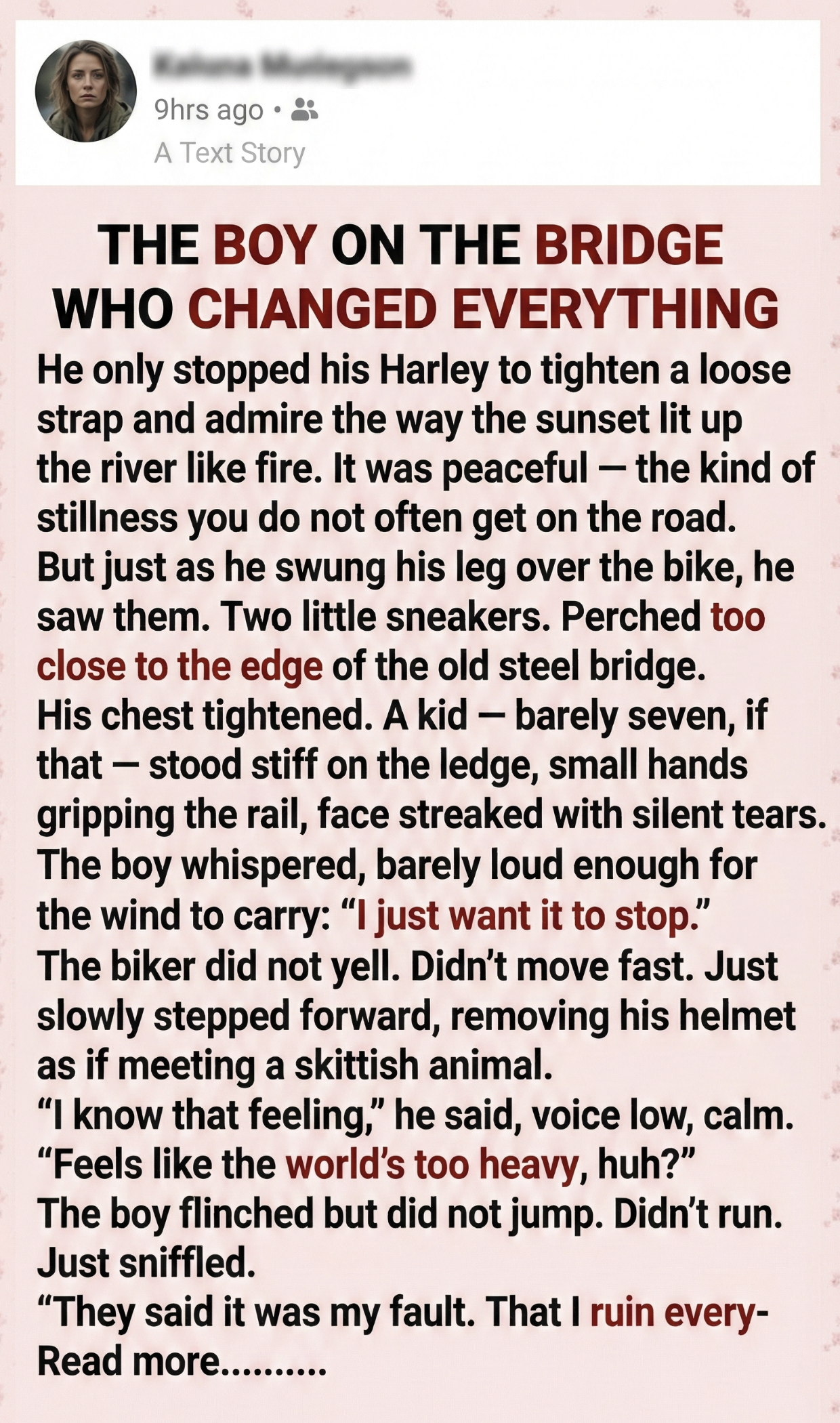
“…thing.” The word choked out of him, swallowed by the wind. “They said I ruin everything.”
The biker, a man named Jack who had spent the last decade running from his own ghosts, felt the world stop. He looked at the boy’s trembling shoulders and saw himself forty years ago. He didn’t panic. He knew that one wrong move, one sudden lunge, and gravity would win.
“That’s a lie,” Jack said, his voice dropping an octave, rumbling like an idling engine. He took one slow, deliberate step closer. “People say stupid things when they’re hurting, kid. But that doesn’t make them true. Look at me.”
The boy hesitated, turning his head just enough to see the man through his tear-blurred eyes.
“I’ve wrecked bikes. I’ve wrecked relationships. I’ve made mistakes that would make your hair curl,” Jack said, unzipping his heavy leather jacket. “But I’m standing here. And you’re standing here. And the only thing you’re about to ruin is the best part of the sunset.”
He gestured to the orange and purple sky reflecting off the water below. “But down there? It’s dark. It’s cold. And there’s no way back up.”
The boy’s grip on the rail loosened, just a fraction. “I don’t want to go home,” he whimpered.
“Then don’t,” Jack said firmly. “Not yet. Step down. Sit on the bike. We’ll figure the rest out. I’m not going anywhere. I promise.”
Jack held out a gloved hand—scarred, calloused, and shaking ever so slightly. It was an offer of a lifeline. For a terrifying ten seconds, the only sound was the rushing water below. Then, the boy took a shuddering breath, released the cold steel railing, and reached out.
Jack grabbed the small hand and pulled him over the barrier, wrapping the boy in a bear hug that smelled of gasoline, leather, and safety. The boy collapsed against him, sobbing into the biker’s chest, releasing the weight he’d been carrying alone.
Jack sat him on the Harley. He took off his oversized helmet and placed it on the kid’s head; it wobbled comically, sliding over the boy’s eyes, and for the first time, a tiny, watery smile broke through the tears.
They sat there for an hour. Jack didn’t make him talk. He just let the boy listen to the rhythmic thump-thump-thump of the engine, a heartbeat stronger than his fear. When the police eventually arrived—called by a passing car—Jack didn’t leave. He waited. He spoke to the officers. He made sure the boy wasn’t just returned to the chaos that drove him to the ledge.
That evening on the bridge didn’t just save the boy; it saved Jack.
He stopped running that day. Jack ended up becoming a fierce advocate for the kid, working with social services to get him into a safe environment with an aunt who actually cared. He became the boy’s mentor, showing up to every baseball game, every graduation, every bad day, with that loud, rumbling Harley. The boy on the bridge grew up to be a counselor who saved hundreds of others, all because one stranger stopped to tighten a strap, saw the pain, and decided not to look away.
It turns out, the boy didn’t ruin everything. He fixed everything.