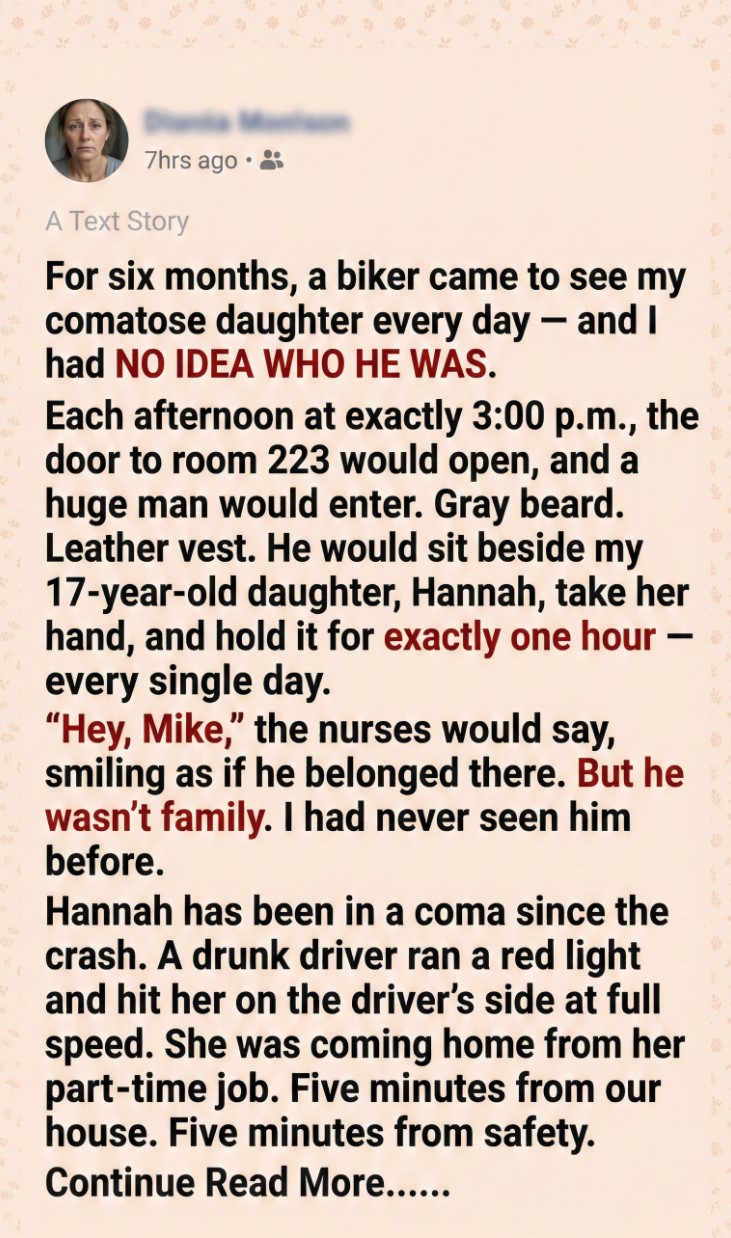
For six months, a biker came to visit my comatose daughter every single day — and I had no idea who he was.
At exactly 3:00 p.m., without fail, the door to Room 223 would creak open. The nurses didn’t even look up anymore. They already knew.
He was impossible to miss. Tall. Broad shoulders. Gray beard that covered half his chest. Leather vest with patches stitched across the back. Heavy boots that echoed against the hospital floor.
“Hey, Mike,” the nurses would say warmly, like he was part of the staff.
But he wasn’t part of anything I knew.
He would walk straight to Hannah’s bedside — my 17-year-old daughter — pull a chair close, take her hand gently in both of his massive ones, and sit there. Not talking much. Just holding it. For exactly one hour. Then he’d nod to the nurses and leave.
Every. Single. Day.
Hannah had been in a coma since the accident. A drunk driver ran a red light and slammed into her driver’s side at full speed. She was five minutes from home. Five minutes from safety. Five minutes from me.
The doctors said the first few months were critical. Then they said we just had to wait. So I waited. And watched this stranger sit with my child like he belonged there.
One afternoon, I finally gathered the courage.
“Excuse me,” I said as he stood to leave. “How do you know my daughter?”
He paused. His eyes — surprisingly soft for a man who looked carved out of stone — met mine.
“I don’t,” he said quietly.
That answer hit me like another crash.
“I was behind her that day,” he continued. “At the intersection.”
My heart stopped.
“I saw the truck run the light. I tried to warn her — honked, flashed my lights — but there wasn’t time.”
He swallowed hard.
“I was the one who pulled her out of the car.”
I had never heard that part. The police report mentioned a bystander who dragged her from the wreck before the car caught fire. They never gave a name.
“That was you?” My voice barely worked.
He nodded. “I held her hand until the ambulance came. Told her to stay with me. Told her she wasn’t alone.” His jaw tightened. “So I figured… I shouldn’t stop now.”
I couldn’t speak. All those afternoons I’d watched him, suspicious. Wondering what right he had to be there.
He had every right.
“She squeezed my hand once,” he added softly. “In the ambulance. I don’t know if it was reflex or not. But I made her a promise. I said I’d keep showing up.”
The room felt different after that. Lighter somehow.
“You don’t have to keep coming,” I whispered.
He looked at Hannah. Tubes. Machines. The steady beep of hope.
“Yeah,” he said. “I do.”
Weeks passed. Then one afternoon, at 3:47 p.m. — forty-seven minutes into his visit — it happened.
Her fingers moved.
At first, I thought I imagined it. But Mike felt it too. His massive shoulders went rigid.
“Hannah?” he said, leaning closer.
Her hand tightened. Just slightly. But this time, it wasn’t reflex.
The nurse called for the doctor. I cried so hard I couldn’t stand. And Mike — the big, leather-clad biker everyone judged in the hallway — bowed his head and whispered, “Thank you.”
Hannah didn’t wake up fully that day. But she started fighting her way back.
And every afternoon at exactly 3:00 p.m., the door to Room 223 still opens.
Only now, when the nurses smile and say, “Hey, Mike,”
I smile too.