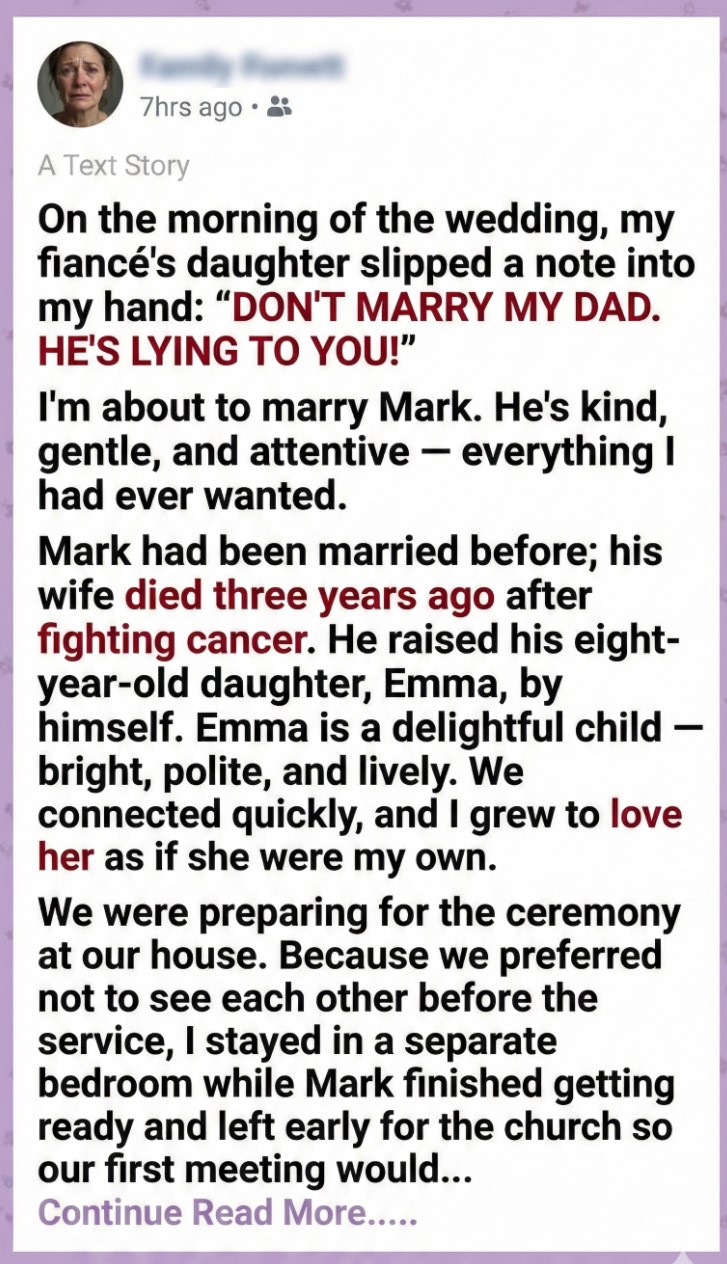
On the morning of the wedding, my fiancé’s daughter slipped a note into my hand.
Her small fingers trembled as she pressed the folded paper into my palm. When I opened it, my heart nearly stopped.
“DON’T MARRY MY DAD. HE’S LYING TO YOU!”
For a moment, the room felt like it was spinning.
I’m about to marry Mark. He’s kind, gentle, and attentive — everything I had ever wanted. Mark had been married before; his wife died three years ago after fighting cancer. He raised his eight-year-old daughter, Emma, by himself.
Emma is a delightful child — bright, polite, and lively. We connected quickly, and I grew to love her as if she were my own.
That’s why the note made no sense.
We were preparing for the ceremony at our house. Because we preferred not to see each other before the service, I stayed in a separate bedroom while Mark finished getting ready and left early for the church so our first meeting would be at the altar.
Emma had come in to show me the bracelet she was wearing. She looked beautiful in her little pale-blue dress.
But her smile didn’t reach her eyes.
After handing me the note, she stepped back quickly, like she’d done something dangerous.
I knelt in front of her.
“Emma,” I said softly, trying to keep my voice steady, “why would you write this?”
Her lip trembled. For a second, I thought she might take it back — say it was a joke.
Instead, she whispered, “Because he’s lying.”
My chest tightened.
“What is he lying about, sweetheart?”
She hesitated, glancing toward the hallway as if afraid someone might hear us.
“He tells you Mommy died because she was sick,” she said quietly. “But that’s not the whole truth.”
A chill ran down my spine.
I had seen the photos. I had heard the stories about hospital visits and treatments. Mark never spoke about it without tearing up.
“What do you mean?” I asked carefully.
Emma’s small hands twisted together.
“They used to fight,” she said. “A lot. Before Mommy got really sick. I heard her crying at night.”
That alone wasn’t shocking. Grief, illness — marriages can strain under that weight.
But Emma wasn’t finished.
“One time,” she continued, “I heard Mommy tell Aunt Lisa that if anything happened to her, it wouldn’t be an accident.”
My breath caught.
“That’s what she said?” I asked.
Emma nodded. “And Daddy told me not to talk about it. He said it would make people think bad things.”
The room felt suddenly too small.
“Did something happen?” I asked gently.
Emma swallowed hard. “The night Mommy went to the hospital… they were fighting again. I heard a loud noise. Like something breaking.”
My mind raced.
Mark had told me she collapsed suddenly. That he found her unconscious and called an ambulance.
“Emma,” I said softly, “did you see anything?”
She shook her head quickly. “No. Daddy told me to stay in my room. He said Mommy fainted.”
There it was again. The word he used every time.
Fainted.
I sat back on my heels, heart pounding.
Children misunderstand things all the time, I reminded myself. They overhear. They imagine.
But the fear in her eyes wasn’t imagination.
“Why tell me now?” I asked.
“Because if you marry him,” she whispered, tears spilling over, “you’ll live with him. And if he gets mad at you too…”
She didn’t finish.
The implication hung heavy between us.
I pulled her into my arms. She clung to me tightly.
Mark had never raised his voice to me. Never shown even a flicker of temper.
But I realized something unsettling: I had only known him during the best version of himself — the grieving widower, the devoted father, the attentive partner.
I had never seen him angry.
A knock at the door startled us both.
“Five minutes!” my maid of honor called cheerfully from the hallway.
Five minutes until I walked down the aisle.
I stood slowly, my mind racing.
“Emma,” I said gently, wiping her tears, “has your dad ever hurt you?”
Her eyes widened. “No! He loves me.”
That mattered.
I took a deep breath.
“I’m not going to ignore what you told me,” I promised. “But I need to talk to him. Today.”
She looked scared. “Are you going to tell him I said something?”
“Yes,” I said honestly. “But I won’t let him be angry at you.”
Another deep breath.
Instead of heading to the car waiting to take me to the church, I picked up my phone.
I called Mark.
He answered immediately. “Hey, beautiful. Ready?”
“Did you tell me everything about the night your wife went to the hospital?” I asked.
Silence.
“What kind of question is that?” he replied, too quickly.
“Emma remembers a fight,” I said. “She remembers something breaking.”
There it was — the shift in his breathing.
“We argued,” he admitted finally. “Of course we argued. She was sick. I was exhausted. We both said things we regret.”
“Was she pushed?” I asked bluntly.
“No!” His voice cracked. “God, no. She collapsed after the fight. I thought she was just overwhelmed. The doctors said the cancer had spread to her brain. There was nothing anyone could’ve done.”
“Why didn’t you tell me about the fight?” I pressed.
“Because I already live with enough guilt,” he whispered. “The last thing I ever said to her was in anger. I didn’t want you to look at me and see the man who failed her.”
Tears blurred my vision.
“Did the police investigate?” I asked.
“Yes,” he said firmly. “There was a report. Medical records. You can look at all of it.”
His voice didn’t sound defensive now. It sounded broken.
“I would never hurt her,” he said. “Or you. Or Emma. I’ve spent three years blaming myself for not being kinder that night.”
I believed grief like that.
But I also believed in caution.
“I’m not coming to the church yet,” I said quietly. “We need to talk. Face to face.”
There was a long pause.
“Okay,” he replied. “I’ll come back.”
When I hung up, Emma looked up at me anxiously.
“Are you still getting married?” she asked.
I brushed a strand of hair from her face.
“I don’t know yet,” I said honestly. “But I promise you something — I will never ignore you. Ever.”
An hour later, Mark walked into the living room instead of a church aisle.
We sat down together. He showed me hospital records, the medical examiner’s report, even the old police file stored in a folder he’d kept all these years.
There were no signs of violence. No hidden secrets. Just two exhausted adults facing the cruelty of illness — and a final argument neither of them got to fix.
Mark broke down when he spoke about it.
“I hated myself for yelling,” he said. “I thought if I told you about that night, you’d see me differently.”
“I do see you differently,” I replied.
He looked crushed.
“I see you as human,” I continued. “Flawed. Grieving. Not perfect.”
Emma watched us from the doorway.
I walked over to her and held out my hand.
“Your mom was scared,” I told her gently. “And so were your dad and you. But nothing bad happened because of anger. The doctors said she was very sick.”
Emma looked at her father.
“Is that true?” she asked.
Mark knelt in front of her. “It’s true. And I should’ve explained better instead of telling you not to talk about it. I was trying to protect you. But I made it worse.”
She hesitated — then threw her arms around him.
I felt the tension in the room finally ease.
Later that afternoon, we stood in a small chapel with only close family present. No dramatic entrance. No perfect timing.
Just honesty.
Before I said “I do,” I looked at Emma and gave her a small nod.
She nodded back.
That morning, I learned something important:
Love isn’t about pretending the past was perfect.
It’s about facing it — together.
And sometimes, the bravest voice in the room belongs to a child holding a folded piece of paper.