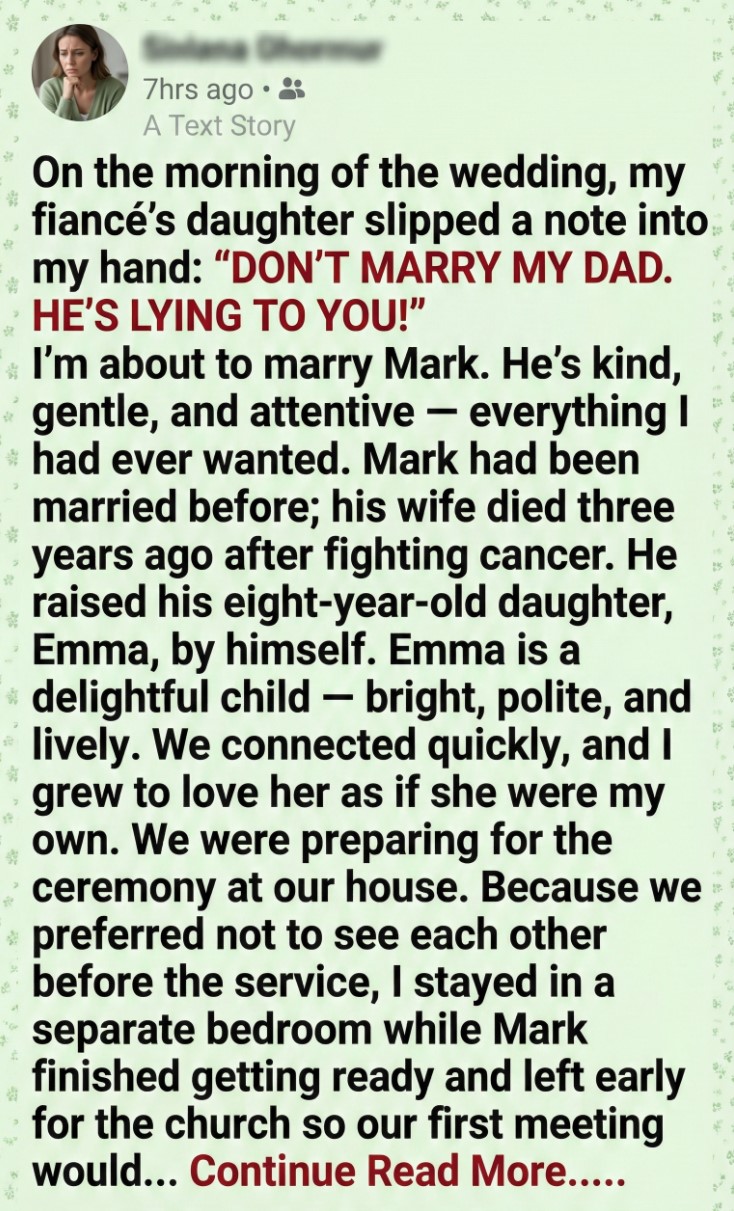
On the morning of the wedding, my fiancé’s daughter slipped a note into my hand:
“DON’T MARRY MY DAD. HE’S LYING TO YOU!”
For a second, I thought it was a childish prank. Emma was only eight. Maybe she was scared of change. Maybe she didn’t want to share her dad.
But when I looked up at her, my heart dropped.
She wasn’t pouting. She wasn’t angry.
She was terrified.
I knelt down carefully so no one else would hear. “Emma,” I whispered, “what do you mean?”
Her small hands twisted in her dress. “He told you my mommy died from cancer,” she said quietly. “But that’s not true.”
My stomach tightened.
“What do you mean it’s not true?” I asked.
“She was sick,” Emma said. “But… that’s not why she died.”
Before she could say more, Mark’s sister called her name from downstairs. Emma squeezed my hand and ran off, leaving me frozen in that bedroom with the note crumpled in my palm.
He told me his wife had died three years ago after a long fight with cancer. He had described hospital rooms, treatments, hope fading slowly. I had cried with him. I had admired his strength — a widower raising his little girl alone.
What could he possibly be lying about?
I picked up my phone with shaking hands and searched his late wife’s name.
I had never done that before. I don’t know why. Maybe because I trusted him. Maybe because grief feels sacred.
This time, I scrolled.
And then I found it.
An old news article.
My breath caught as I read the headline.
She hadn’t died in a hospital bed.
She had died in a car accident.
The article mentioned that she had been driving alone late at night when her car veered off the road. It also said she had recently been discharged from a rehabilitation center.
Rehabilitation.
For prescription drug dependency — pain medication she’d started taking during her cancer treatment.
The article didn’t accuse anyone of anything. It simply stated the facts.
I sat there, staring at the screen.
He hadn’t lied about her being sick.
But he had lied about how she died.
When Mark came to get me for the ceremony, I was still holding my phone.
“You look pale,” he said gently. “Nervous?”
I held up the article.
He didn’t even need to read it.
His face told me everything.
“Why?” I asked quietly.
He closed the door behind him.
“She was in recovery,” he said. “She relapsed. I was supposed to pick her up that night. We had argued earlier. I didn’t answer her calls.”
His voice broke.
“She drove. She was high. She lost control.”
Silence filled the room.
“You told me it was cancer,” I said.
“She had cancer,” he insisted. “That’s how it started. The medication. The addiction. The rehab. The relapse. I just… I couldn’t say the rest out loud anymore.”
He ran a hand through his hair.
“People judge. They assume things. I didn’t want you to think she was irresponsible. Or that our home was chaotic. Or that I failed her.”
“And Emma?” I asked. “What does she know?”
“She knows her mom was sick,” he said. “She knows there was an accident. She heard more than I realized.”
I thought of Emma’s frightened eyes.
“She thinks you’re lying to me,” I said.
“I was trying to protect all of us,” he whispered.
I looked at the man I loved — kind, steady, patient Mark — and saw something different.
Not a monster.
A man carrying guilt so heavy he rewrote the story to survive it.
“You should have told me,” I said. “Not because of judgment. But because marriage can’t start with half-truths.”
Tears filled his eyes. “I was afraid you’d walk away.”
I thought about Emma. About the note in my hand. About the courage it took for an eight-year-old to protect someone she cared about.
Then I took a deep breath.
“We’re not going to the church,” I said.
His face fell.
“Not like this,” I continued. “We’re going to sit down. The three of us. And we’re going to tell the truth. No more protecting. No more hiding.”
He stared at me.
“After that,” I said softly, “if I still feel like I know the whole story — the real one — then we’ll decide what to do.”
An hour later, the guests were calling, confused. The ceremony was delayed.
Emma sat between us on the couch, clutching her bouquet.
Mark told her everything — in gentle words, but honest ones. He apologized for pretending. He apologized for not trusting that we could handle the truth.
Emma cried.
So did he.
And so did I.
But something shifted in that room. The air felt lighter.
Because truth — even painful truth — is lighter than secrets.
We didn’t get married that morning.
We postponed it.
Six months later, after counseling, long conversations, and a lot of rebuilding trust, we stood in that same church.
This time, there were no notes.
No lies.
Just three people choosing each other — honestly.
And when Emma walked down the aisle in her little white dress, she smiled at me.
Not afraid.
Just certain.