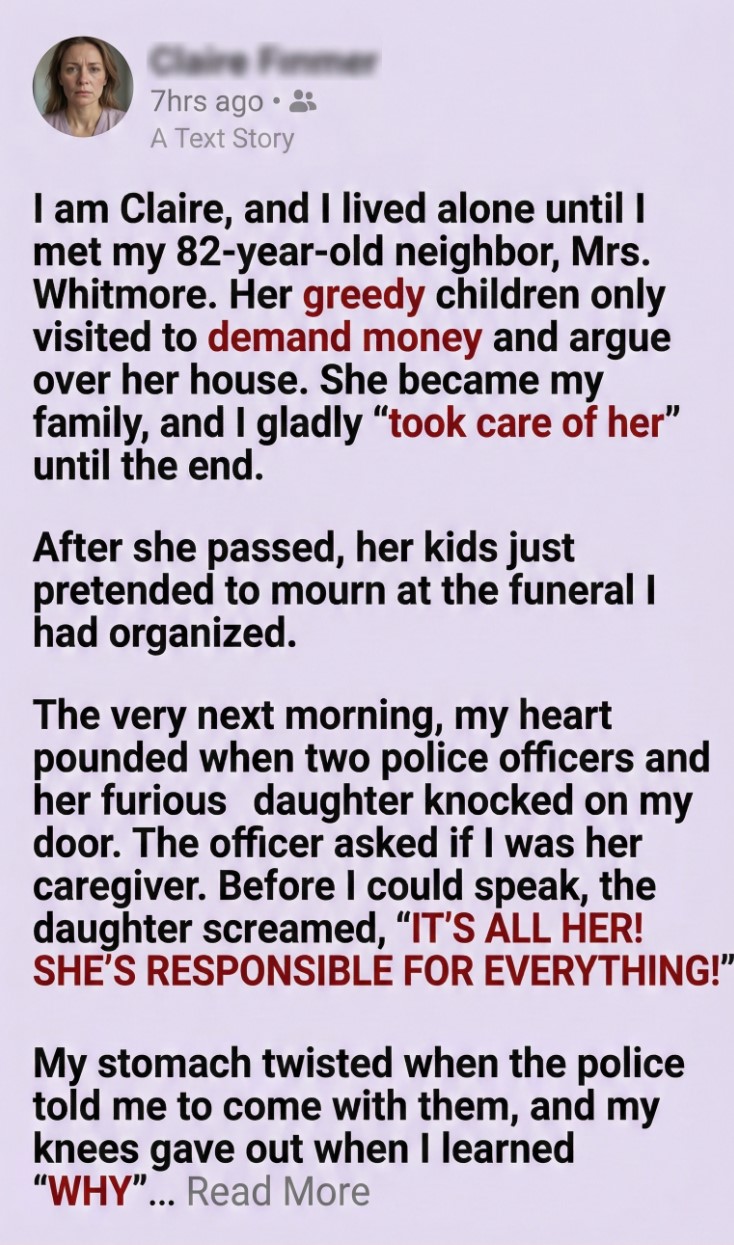
I am Claire, and I lived alone for years in the small blue house at the end of Maple Street. My days were quiet—too quiet sometimes—until Mrs. Whitmore moved in next door.
She was 82 when I first met her. I still remember the way she smiled at me over the hedge, her silver hair pinned neatly in place, her hands trembling slightly as she tried to carry in her groceries. That was how it started. I offered to help. She invited me in for tea. Before long, we had become part of each other’s daily lives.
Her children, however, were another story.
They rarely visited. And when they did, their voices carried through the thin walls—sharp, impatient, cruel. They argued about money. About the house. About “what’s fair.” I never once heard them ask how she was feeling.
After one particularly harsh visit, Mrs. Whitmore sat at her kitchen table, staring at her untouched tea.
“They’re just waiting,” she whispered. “Waiting for me to be gone.”
From that day forward, I did what I could. I drove her to appointments. I cooked her meals. I sorted her medications. I kept her company during long evenings when the house felt heavy with silence. She became the family I never had.
“I don’t know what I’d do without you, Claire,” she would say, squeezing my hand.
When her health began to decline, I was there every day. I held her hand in the hospital. I brought her favorite blanket. And on her final night, I sat beside her bed as she slipped away peacefully.
I arranged the funeral myself. I chose her favorite hymns. I placed white roses on her casket. Her children stood in the front row, dabbing dry eyes, accepting condolences as if they had been devoted all along.
The morning after the funeral, I barely slept. My heart was heavy, but I felt I had honored her the best I could.
Then came the knock.
Two police officers stood on my porch. Behind them was her daughter—face flushed, eyes blazing.
“Are you Claire?” one officer asked calmly.
“Yes,” I said, my voice unsteady.
“Were you Mrs. Whitmore’s caregiver?”
Before I could answer, her daughter stepped forward, pointing a shaking finger at me.
“IT’S ALL HER! SHE’S RESPONSIBLE FOR EVERYTHING!”
My stomach twisted. “What are you talking about?”
“She manipulated my mother!” the daughter screamed. “She made her change the will!”
The world seemed to tilt.
The officer cleared his throat. “Ma’am, we need you to come with us to answer some questions.”
My knees nearly gave out.
At the station, I learned why they had come. Mrs. Whitmore had updated her will six months earlier. She had left the majority of her estate—not to her children—but to me.
I hadn’t known.
She had also left a letter.
The officers handed it to me. My hands trembled as I unfolded it.
“Claire,” it read, “if you are reading this, I am gone. I want you to know that you gave me more love in these last years than I received in decades. My children will not understand this decision. But I made it freely, with a clear mind and a full heart. You did not ask for anything. That is exactly why you deserve it.”
Tears blurred my vision.
The investigation took weeks. Doctors confirmed she had been mentally sound when she changed her will. The lawyer testified that she had come alone. There was no coercion. No manipulation.
In the end, the police found no wrongdoing.
But her children’s anger did not disappear. They contested the will. They spread rumors. They told neighbors I had taken advantage of a lonely old woman.
What they didn’t know was that I would have given every cent back just to have one more afternoon at her kitchen table.
Eventually, the court upheld the will.
I used part of the money to establish a small community fund in Mrs. Whitmore’s name—providing assistance to elderly neighbors who had no one to check on them. It felt like something she would have loved.
The rest? I kept enough to secure my future.
But what I truly inherited wasn’t the house or the savings.
It was proof that kindness matters. That love given freely is never wasted. And that sometimes, family isn’t the people who share your blood—it’s the ones who show up when no one else does.
Even now, when I sit in her old garden, I can almost hear her voice on the breeze.
“You were my family, Claire.”
And she was mine.