I booked a window seat specifically for the six-hour flight to London. I wanted to sleep against the wall, and frankly, I paid extra for the privilege. But the moment I sat down, the man in the middle seat, 14B, tapped my shoulder.
“Excuse me,” he said, gesturing to the little girl in the aisle seat, who looked about seven years old and was already sniffling. “My daughter wants to look out the window. Mind switching?”
I looked at the aisle seat. It was right next to the beverage cart path and offered no place to lean my head. “I’m sorry,” I said politely. “I booked this seat specifically to sleep. I’m going to stay here.”
The man huffed, rolling his eyes. “Seriously? She’s a child. You’re a grown woman but still very immature.”
I put my headphones on, refusing to engage, but it didn’t help. The girl, sensing her father’s irritation, began to wail. She didn’t just cry; she screamed. She kicked the seat in front of her. She shouted about being bored, about being hungry, about not seeing the clouds.
And the father? He did absolutely nothing. He put on expensive noise-canceling headphones, pulled an eye mask over his face, and completely checked out, leaving the rest of the row—and the passengers around us—to deal with his daughter.
Two hours in, the situation was unbearable. The girl was hyperventilating. The flight attendant, a woman named Sarah with infinite patience, came over to try and calm the child down. She offered juice, coloring books, anything. The father didn’t even stir.
Finally, Sarah stood up, looked at me with a sympathetic but serious expression, and motioned for me to follow her to the back galley.
I unbuckled and squeezed past the sleeping father and the sobbing girl. When I got to the back, I expected a lecture, or maybe a request to move seats just to keep the peace.
“I’m so sorry about him,” I started to say.
“It’s not your fault,” Sarah said, her voice hushed. She looked shaken. “But you need to see this. The little girl… she was looking for a snack in her backpack and handed me this note. She said her mommy told her to give it to her daddy if he ‘wouldn’t wake up’ to help her.”
Sarah handed me a piece of folded stationary.
I hesitated, then looked at the handwriting. It was sharp and hurried.
Just then, the father appeared in the aisle. He had finally woken up, annoyed that his human shield—me—was gone and his daughter was loud. He stormed back to the galley to demand why the stewardess wasn’t doing her job.
“Sir,” Sarah said, her voice steely. She handed him the paper. “Your daughter had this.”
He snatched it, looking ready to tear into us. But as he read the first line, he froze.
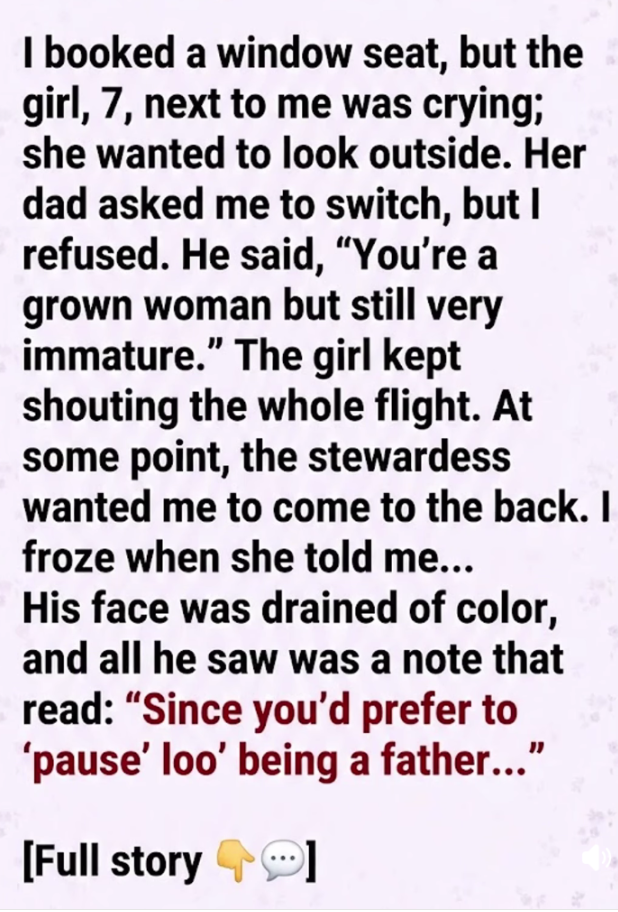
“Since you’d prefer to ‘pause’ on being a father whenever it suits you, I’ve decided to make it permanent. You won’t find us at arrivals. My lawyer has the papers. Enjoy your flight—it’s the last quiet time you’ll have for a while.”
His face was drained of color. The arrogance vanished, replaced by sheer panic. He looked back at his seat, where his daughter was finally quiet, holding a juice box, and then back at the note. He had spent the flight ignoring his child to prove a point to a stranger, completely missing that he had just lost his wife.
I walked back to my seat and sat down. He spent the rest of the flight staring blankly at the seatback pocket, wide awake.