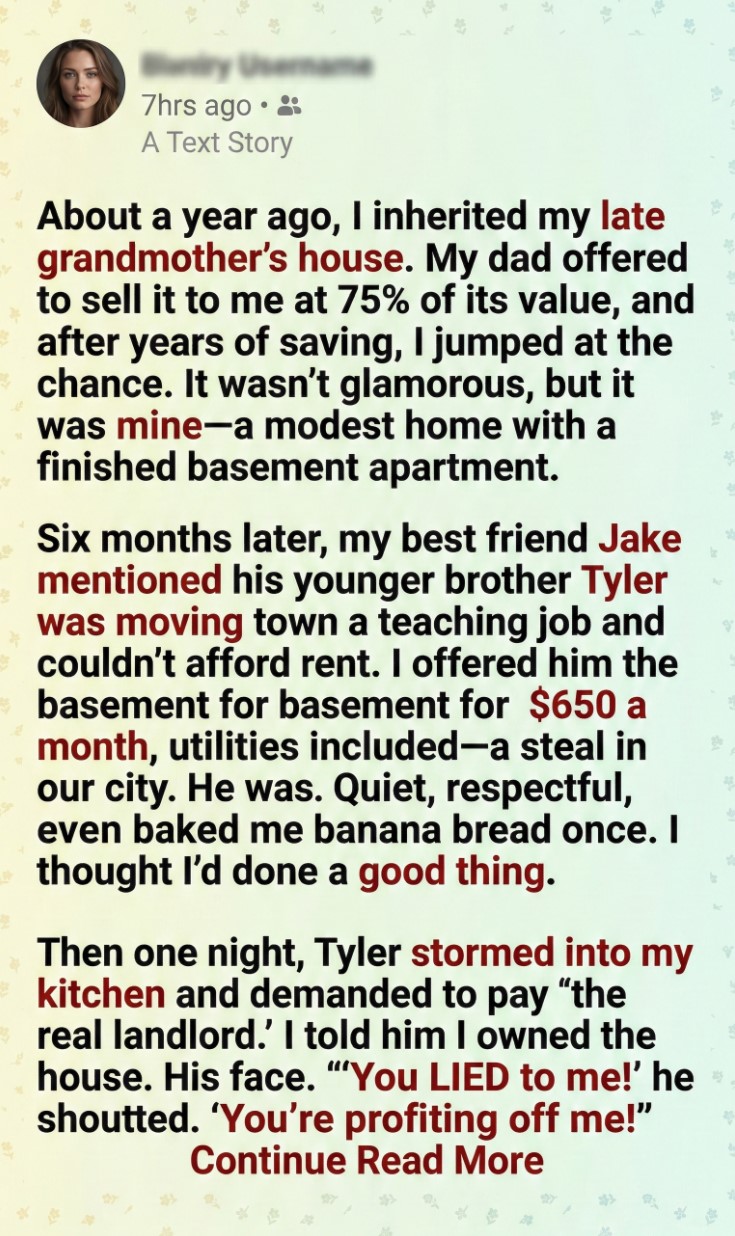
I just stared at him.
“Profiting off you?” I repeated slowly. “Tyler, you’re paying $650 a month. Utilities included. That barely covers the property tax and bills.”
“That’s not the point!” he snapped. “You made it sound like you were just renting the basement. You never said you owned the whole place!”
“I didn’t think I needed to,” I said, confused. “Why does it matter?”
He paced across my kitchen like I’d committed some massive betrayal. “Because Jake told me your dad sold you the house cheap. Seventy-five percent of its value? You’re sitting on equity and charging me rent. That’s messed up.”
It took a moment for his words to sink in.
“So… you’re angry because I bought my own house at a discount? From my father?”
“You could’ve let me stay for free,” he shot back. “Or at least cheaper. You don’t need the money.”
I felt something shift inside me then. The guilt I’d been feeling—wondering if I’d somehow misled him—evaporated.
“I saved for years,” I said calmly. “I drained my account to buy this place. I pay the mortgage. I handle repairs. When the water heater broke last month, that was me. When the roof needs replacing, that’s me too.”
He opened his mouth, but I continued.
“You’re not paying for the house. You’re paying for a private apartment in a good neighborhood at half the market rate. I thought I was helping you.”
“You’re still making money off me!” he insisted.
“No,” I replied. “I’m covering expenses. And even if I were making a small profit… that’s how renting works.”
The silence that followed was thick.
“I think you need to decide something,” I added quietly. “If you believe I’m exploiting you, you shouldn’t stay here.”
His face tightened. “So you’re kicking me out?”
“I’m saying if you don’t trust me, this arrangement won’t work.”
He stormed back downstairs without another word.
The next morning, Jake called.
“Hey… Tyler told me what happened.”
“Did he tell you he thinks I should let him live here for free?” I asked.
Jake sighed. “He’s stressed. New job, student loans… he feels stupid for not realizing you owned the house.”
“So this is about pride?”
“Partly,” Jake admitted. “He thought you were just a middle person. Not the actual owner.”
I rubbed my temples. “I never hid it.”
“I know,” Jake said. “He just… assumed.”
Two days later, Tyler knocked on my door.
He looked different. Less angry. More embarrassed.
“I overreacted,” he said stiffly. “I guess I felt weird knowing I was paying my friend’s best friend.”
“You’re paying your landlord,” I corrected gently. “Who also happens to be your friend’s best friend.”
He managed a small smile.
“I talked to a coworker,” he continued. “She’s paying $1,200 for a studio smaller than my basement. So… yeah. I see it now.”
I nodded. “I never wanted this to be awkward.”
“It won’t be,” he said quickly. “I’m sorry for saying you lied. You didn’t.”
We stood there for a moment.
“Look,” I added, “if it makes you more comfortable, we can sign a simple lease. Clear terms. Clear expectations.”
He exhaled in relief. “Yeah. I’d like that.”
Things settled after that.
He kept paying rent. I kept fixing things when they broke. We developed a respectful distance, the kind that works better than forced friendship.
And about three months later, Tyler got a raise at work.
He knocked on my door again—but this time holding banana bread.
“Guess I’m officially not being exploited,” he joked.
I laughed. “Guess not.”
Owning that house wasn’t glamorous. It came with repairs, bills, and uncomfortable conversations.
But it was mine.
And I finally understood something important:
Being generous doesn’t mean undervaluing what you worked for.
Sometimes the hardest lesson isn’t about money.
It’s about boundaries.