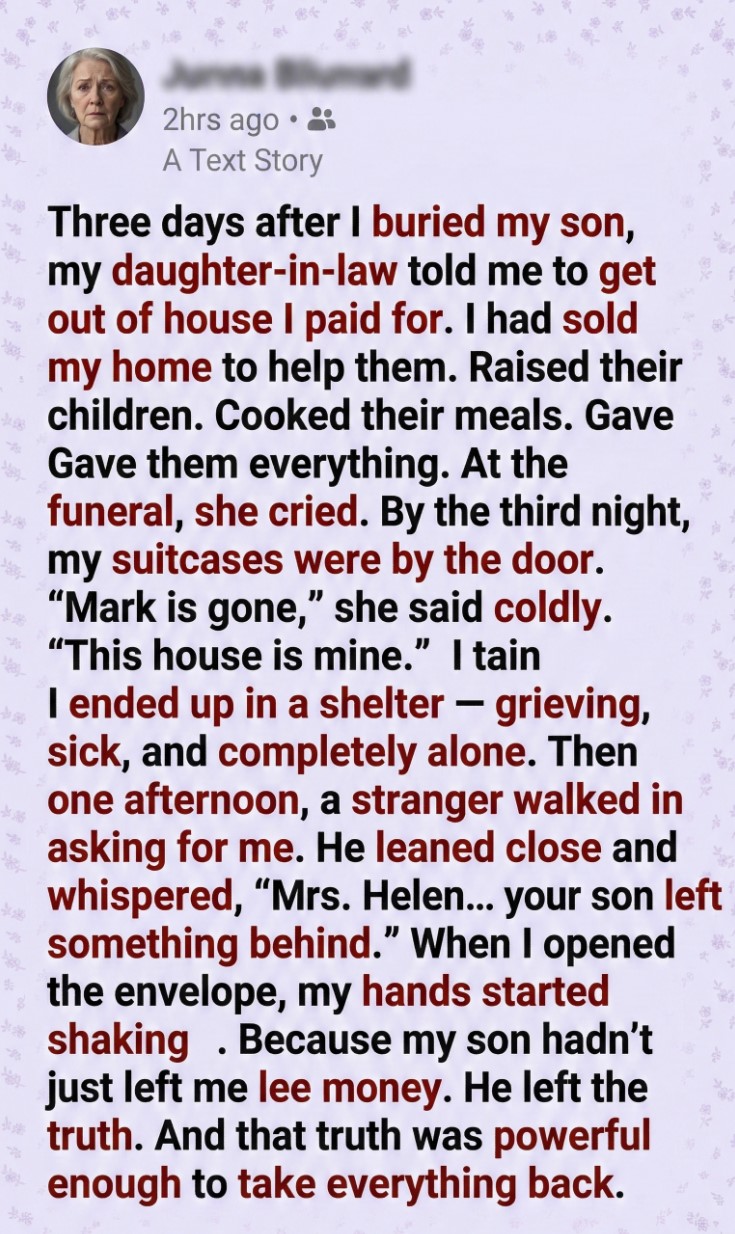
My hands trembled so badly I had to sit down on the narrow shelter cot.
Inside the envelope was not just a letter — but copies of documents. Bank transfers. Property records. And a notarized statement with my son’s signature.
The stranger introduced himself as Daniel, my son’s attorney.
“Mark came to see me two months before he passed,” he said gently. “He was worried.”
Worried.
The word cut through me.
Daniel explained everything. The money I gave them when I sold my home? It hadn’t been a gift. Mark had insisted it be recorded as a loan tied to partial ownership of the house. My name was on a legal agreement. Quiet. Protective. Hidden.
“He didn’t want you to feel uncomfortable living there,” Daniel said. “But he also didn’t want you left with nothing.”
Tears streamed down my face — not just from grief, but from pride.
My son had known.
The letter was last.
“Mom,” it began, in his familiar handwriting. “If you’re reading this, it means I didn’t get the chance to fix everything myself. I love my wife, but I’ve seen changes in her. I need to know you’ll be safe no matter what.”
He wrote about gratitude — for the years I babysat, cooked, and supported them. He wrote about how he never wanted me to sell my house, how guilty he felt for accepting it.
And at the bottom, one final line:
“You will never be a guest in a home you helped build.”
Two weeks later, we went to court.
My daughter-in-law looked confident when she walked in. That confidence faded as Daniel presented the documents. The signed agreement. The proof of funds. The clause stating that upon my son’s death, ownership transferred fully to me if the loan was unpaid.
It was unpaid.
Completely.
The judge ruled swiftly.
The house was mine.
Not hers.
When I returned, the locks had already been changed — by order of the court. She stood on the porch, furious, shouting that it wasn’t fair.
Fair.
There is nothing fair about burying your child.
But there is justice.
I didn’t scream. I didn’t gloat. I simply walked past her into the living room I once decorated for Christmas mornings.
“I hope you find peace,” I told her quietly. “But you won’t find it here.”
She left with her suitcases — just as I once had.
That night, I slept in my own bed.
The house was silent, heavy with memory. I cried for my son until my chest hurt. Winning didn’t bring him back. Nothing could.
But he had protected me.
Even in death.
And as morning sunlight filled the kitchen, I made coffee in the same mug he gave me years ago. I realized something powerful:
She thought she had taken everything.
But my son had left me what mattered most.
Dignity.
Security.
And the truth.