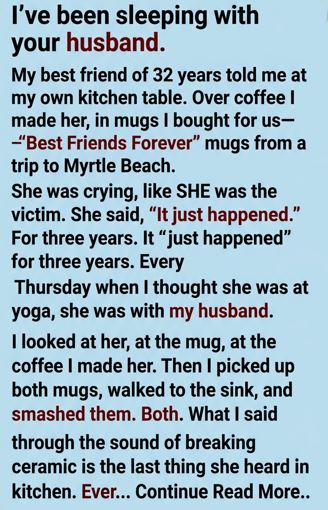
The sound of the mugs shattering echoed through the kitchen. My best friend flinched. I stared at the broken pieces in the sink and said, “You didn’t just betray me. You spent three years watching me trust you.” She started sobbing. “I never meant for this to happen.” I laughed. Not because it was funny, but because it was absurd. Three years. One thousand ninety-five days. Hundreds of choices. Thousands of lies. Nothing about that “just happened.” I pointed toward the front door. “Get out.” Her eyes widened. “Please, let me explain.” “No.” “Can we talk about this?” “No.” “After thirty-two years, you’re just throwing me away?” I looked directly at her. “You threw me away three years ago.” She grabbed her purse and walked out. The door closed, and just like that, thirty-two years of friendship ended. I sat alone in the kitchen for nearly an hour. Then I picked up my phone and called my husband. “Come home.” The moment he walked through the door, he knew. His face turned pale. “She told you.” It wasn’t a question. I nodded. For a few seconds neither of us spoke. Then came the excuses, the apologies, the promises, and the tears. I listened quietly. When he finally stopped talking, I asked one question. “Did you love her?” His silence gave me the answer. Not because he did, but because he didn’t know. That hurt even more. He risked our marriage, our family, and our future for something he couldn’t even define. That night he slept in the guest room. The next day I met with an attorney. The day after that, I met with a financial advisor. Within a month, I had a plan. Not revenge. A future. My husband spent the next year trying to repair what he’d broken. Therapy, letters, flowers, promises. For the first time in our marriage, he seemed willing to do the work. The problem was that he was three years too late. Trust isn’t a switch. You can’t simply turn it back on. Eventually I filed for divorce. The process was surprisingly calm. There were no screaming matches, no dramatic courtroom scenes. Just paperwork, signatures, and acceptance. Two years later, I heard through mutual friends that my former best friend and my ex-husband had officially become a couple. Everyone expected me to be devastated. I wasn’t. The truth was stranger. I felt relieved. Because now they belonged to each other, and neither belonged in my life. Then something happened nobody expected. Eighteen months later, they broke up. Messily. Apparently trust became an issue. The irony was almost too perfect. A relationship built on deception eventually drowned in suspicion. One afternoon, years later, I ran into my former friend at a grocery store. Time had changed both of us. She looked tired, older, and sad. We stood in awkward silence for a moment. Then she said quietly, “I think about you all the time.” I nodded. She wiped her eyes. “Losing you was the biggest mistake of my life.” For a second, I saw the woman I’d known since childhood, the one who celebrated birthdays with me and stood beside me during life’s hardest moments. Then I remembered she was also the woman who lied to me for three years. Both versions were true. People are complicated that way. “I hope you’re doing well,” I said. She looked surprised. “That’s all?” I smiled gently. “What else is there to say?” She opened her mouth, then closed it. There was nothing left. No argument. No explanation. No defense. Just consequences. We said goodbye and walked in opposite directions. As I pushed my cart toward the parking lot, I realized something important. Forgiveness doesn’t always mean reconciliation. Sometimes forgiveness simply means refusing to carry the weight anymore. I had spent years believing she took something from me—my marriage, my friendship, my trust. But standing there under the afternoon sun, I finally understood. She hadn’t taken my future. Only my past. And the future still belonged to me. That evening, I went home to a quiet house. A peaceful house. A house free from lies. I made myself a cup of coffee, poured it into a new mug, sat by the window, and watched the sunset paint the sky in shades of gold and orange. For the first time in a long time, I felt whole. A few months later, my daughter stopped by for dinner. As we sat talking, she suddenly reached across the table and squeezed my hand. “Mom,” she said softly, “I’m proud of you.” “For what?” I asked. She smiled. “For choosing yourself when it would have been easier to stay.” Her words stayed with me long after she left. Because she was right. The hardest decision I ever made wasn’t ending a marriage or losing a friendship. It was believing that I deserved better. And once I believed that, everything changed. Years passed. New friendships entered my life. New memories replaced old wounds. The pain that once felt unbearable became a lesson instead of a burden. Sometimes I still think about that afternoon in my kitchen, the mugs, the confession, the sound of breaking ceramic. But now, when I remember it, I don’t feel anger. I feel gratitude. Because that was the moment my old life ended—and my better one began. Sometimes the worst betrayal becomes the doorway to the peace you never knew you needed. And looking back, I wouldn’t relive the pain. But I would absolutely choose the freedom that came after it.
My Best Friend Slept With My Husband for 3 Years. She Confessed at My Kitchen Table—But What Happened Next Changed All Three of Our Lives Forever.