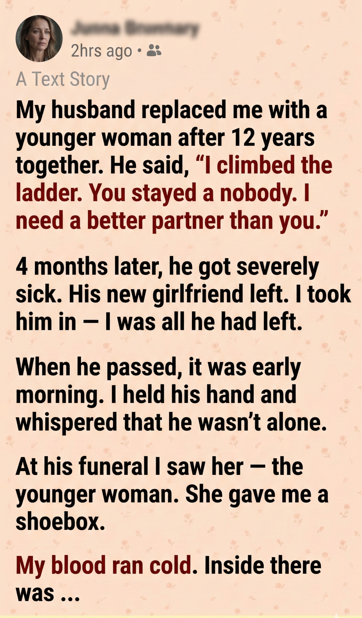
After twelve years of marriage, my husband didn’t just walk out—he erased my presence as if it had never mattered.
He stood in the kitchen we had shared for over a decade, dressed in a suit I had pressed that very morning, and said words that still feel like bruises in my chest: “I’ve moved on in life. You stayed the same. I need someone who matches where I am now.”
Twelve years of shared life—our home, our habits, private jokes, slow Sunday mornings—reduced to a verdict on my worth.
Within weeks, he was gone, replaced by someone younger, polished, and seemingly fitting perfectly into the life he wanted. I packed my things with trembling hands and moved into a small apartment, its fresh paint a stark reminder of isolation. Nights stretched endlessly as I replayed every memory, searching for the moment I became dispensable.
Then, four months later, my phone rang.
He was gravely ill—a disease that stripped away pride, ambition, and appearances, leaving only fear. The younger woman had already vanished. She hadn’t stayed long enough to learn how to care for him.
I didn’t stop to think. Perhaps it was habit, perhaps love, or maybe the part of me that never learned to close my heart. I brought him into my home. I cooked meals he could tolerate, managed his medications, and sat beside him through long, quiet nights as machines hummed in the background.
He wasn’t the man who had left me. He was smaller, quieter, diminished. The confidence that once commanded attention was gone, replaced by someone afraid of dying alone. Sometimes he tried to speak apologies, but the words faltered. I didn’t need them—I had learned that love doesn’t always require explanations.
He passed just after dawn. I held his hand and whispered that he wasn’t alone.
At the funeral, I noticed her—the younger woman—standing awkwardly at the edge of the crowd. Later, she approached, holding a small shoebox.
Inside was a journal.
Page after page of confessions written during the months we were apart. Words he never spoke aloud. Regret scrawled in uneven handwriting. Over and over, he admitted that losing me was his greatest mistake, repeatedly calling me the love of his life, as if repetition could undo the pain he had caused.
She explained she had discovered it by accident. She read enough to realize she had never been his future—only a distraction. When he became ill, she left. She had intended to destroy the journal, but his death stopped her.
I wept harder than I had in years—not from triumph, but from grief over what pride and ego had destroyed.
Later, his lawyer informed me that everything he owned—every account, every asset—was left to me. He insisted I was the only one deserving of it.
I would have given it all back for those four lost months.
They linger as shadows over a love that never truly ended—a reminder of time wasted proving something we both already knew.
Still, I am profoundly grateful. Grateful that I opened my home to him when he had nowhere else to turn, that I chose kindness over resentment. Without that, the regret would have been unbearable.
Love rarely gets a second chance. Sometimes, it only gets one final, fleeting moment of grace.