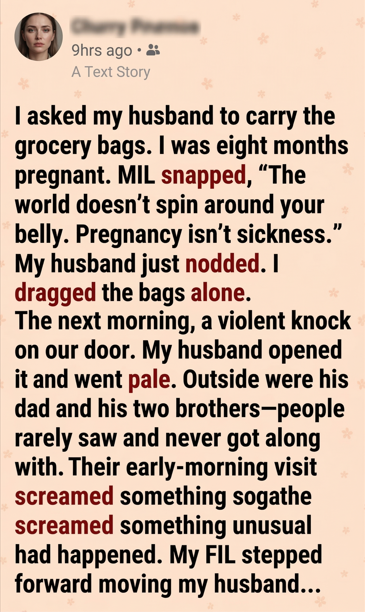
I was eight months pregnant when I asked my husband to help me carry the grocery bags up the stairs.
It wasn’t a dramatic request. Just a quiet, exhausted one—my back aching, my ankles swollen, the baby pressing low and heavy. The bags were full of ordinary things: rice, milk, vegetables, prenatal vitamins. Life things.

He stood there, keys still in his hand, hesitating like I’d asked him to move a mountain.
Before he could answer, my mother-in-law snapped from the kitchen, her voice sharp and dismissive.
“The world doesn’t spin around your belly,” she said. “Pregnancy isn’t a sickness.”
The words hit harder than the weight in my arms.
My husband didn’t argue. He didn’t even look at me. He just nodded—once—like she’d stated an obvious truth.
So I bent down, picked up the bags myself, and started dragging them inside.
Each step felt heavier than the last. Not just physically—emotionally. I wasn’t crying. I’d learned not to. Crying only gave her something else to criticize. But with every clink of glass and rustle of plastic, something inside me went quiet.
That night, I barely slept. The baby kicked as if restless too, and I lay there wondering how I’d ended up feeling so alone in a house full of people.
The next morning, just after sunrise, there was a violent knock on the door.
Not a polite tap. Not a neighborly knock. This was loud, urgent, almost angry.
My husband groaned, pulled on a shirt, and went to open it. I followed slowly, one hand on my belly, heart already racing.
The color drained from his face the second he saw who was outside.
Standing on the porch were his father and his two brothers.
We rarely saw them. And when we did, it was stiff, awkward, brief. There had been old arguments, unspoken resentments, and years of distance. Their presence—together, this early—meant something was wrong.
My father-in-law didn’t waste time.
He stepped forward, gently but firmly moving my husband aside as if he weighed nothing, and looked straight at me.
“I came to apologize,” he said. His voice was steady, calm—but serious. “For raising a lazy, ignorant man who doesn’t appreciate his wife or his unborn child.”
The silence that followed was suffocating.
My mother-in-law froze. My husband stood there, stunned, mouth slightly open, saying nothing.

My father-in-law didn’t look at them again. His eyes stayed on me.
“I heard what happened yesterday,” he continued. “About the groceries. About how you were spoken to. About how you were treated.”
My throat tightened.
“I raised my sons to be strong,” he said. “But strength isn’t lifting your voice or asserting dominance. Strength is responsibility. Care. Showing up when it matters.”
He paused, then took a breath.
“And I’ve come to make an announcement,” he said. “I’m going to the lawyer’s office today to change my will.”
My husband’s head snapped up.
“I had planned to leave everything to my sons,” my father-in-law went on. “That was the plan for years. But plans change when people show you who they really are.”
He turned slightly, gesturing toward his two other sons, who stood quietly behind him.
“These two have proven themselves—again and again. And then there’s you,” he said, looking back at me. “My daughter-in-law.”
I felt my eyes sting.
“Even pregnant,” he said, “even exhausted, even unsupported—you showed more strength yesterday than my son did standing comfortably with empty hands.”
My husband looked like he’d been punched.
“You carried the weight when you shouldn’t have had to,” my father-in-law said softly. “And you did it without complaint. That tells me everything.”
He straightened his shoulders.
“So here’s how it will be. The strongest members of my family will inherit what I leave behind. My two sons—and you.”
My mother-in-law finally found her voice, sputtering in disbelief. My husband tried to speak, then stopped.
But my father-in-law raised a hand.
“This isn’t about punishment,” he said. “It’s about values. And today, I saw them clearly.”
Then he did something I never expected.
He reached out and gently placed a hand on my shoulder.
“Thank you,” he said. “For protecting my grandchild. Even when no one protected you.”
They left shortly after. No shouting. No further explanations.
Just truth—delivered cleanly, unmistakably.
The house felt different after that. Quieter. Smaller.
My husband didn’t speak to me for a long time. When he finally did, his voice was low, uncertain. Something in him had cracked—but whether it would change him, I didn’t yet know.
What I did know was this:
In that moment, I realized my father-in-law’s wisdom, empathy, and quiet kindness ran deeper than I had ever imagined. He saw strength where others overlooked it. He understood fairness without cruelty.
And for the first time in months, I placed a hand on my belly and felt something close to peace.
Because someone had finally seen me.
And that changed everything.