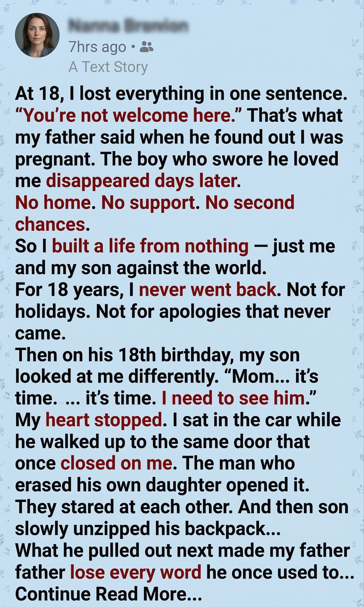
When I was eighteen, my father told me I had two choices.
“Get rid of it,” he said flatly, standing in the kitchen I’d grown up in. “Or get out.”
I chose my baby.
He chose the door.
I still remember the sound of it closing behind me. I had one duffel bag, a swollen belly, and nowhere to go. The boy who had sworn he’d “always be there” lasted exactly three weeks after that. He said he wasn’t ready. He said it wasn’t fair. Then he blocked my number.
So it was just me.
I worked double shifts at a diner until my feet swelled so badly I could barely stand. I slept on a friend’s couch until she moved away. I found a tiny studio apartment with peeling paint and a landlord who didn’t ask questions.
When my son was born, I named him Daniel.
Because it means “God is my judge.”
And I figured I’d had enough human judgment for one lifetime.
For eighteen years, I never went back home.
Not for Thanksgiving.
Not when my mother passed away — I wasn’t told until weeks later.
Not when neighbors saw me in town and looked away awkwardly.
I built a life without them.
It wasn’t glamorous. It wasn’t easy. But it was ours.
Daniel grew up kind. Quiet. Observant. He asked about his grandfather only a handful of times when he was small.
“Why doesn’t Grandpa visit?”
I always answered carefully. “Sometimes adults make decisions they don’t know how to undo.”
When Daniel turned eighteen, we celebrated with a homemade cake and cheap decorations from the dollar store — a tradition we’d kept every year.
After we cleaned up, he looked at me differently. Older. Steadier.
“Mom,” he said gently, “I need to see Grandpa.”
My stomach tightened.
“Why?” I asked.
“I’ve been preparing for this,” he said.
Preparing?
I didn’t understand what that meant, but I saw something in his eyes I’d never seen before — not anger, not revenge. Resolve.
A week later, we drove to the same house I hadn’t stood in front of for eighteen years.
The paint was different. The trees were taller. But the porch light was the same.
I stayed in the car.
My hands shook against the steering wheel as Daniel walked up the path. He knocked once.
The door opened slowly.
My father stood there.
Older. Smaller somehow. His hair thin and gray. His shoulders bent in a way I didn’t remember.
They stared at each other for a long moment.
Then Daniel spoke.
“Hi. I’m Daniel.”
My father’s eyes flicked toward the driveway, and I saw recognition dawn across his face.
He looked back at my son.
“You look like her,” he said quietly.
Daniel didn’t smile.
He slipped off his backpack and unzipped it carefully.
From inside, he pulled out a thick folder — organized, tabbed, neat.
He handed it to my father.
“What’s this?” my father asked.
“My college acceptance letters,” Daniel said calmly. “And my scholarship offers.”
There were four universities.
One full academic scholarship.
Two partial athletic scholarships.
One honors program invitation.
Daniel had worked for years — late nights studying, early mornings training, tutoring younger kids for extra cash.
He had never once asked for help from the man standing in that doorway.
“I wanted you to see something,” Daniel said.
My father’s hands trembled slightly as he flipped through the papers.
“I wanted you to see what she built,” Daniel continued. “By herself.”
The silence that followed was heavier than anything I’d felt in eighteen years.
“She never talked badly about you,” Daniel added. “Not once.”
That part made my chest tighten.
My father swallowed hard.
“I thought…” he began, but the sentence didn’t finish.
Daniel didn’t wait for an apology.
“I’m not here for money,” he said. “And I’m not here to argue. I just wanted you to know that when you shut the door on her, you shut it on this too.”
He gently tapped the folder.
“And we were fine anyway.”
My father looked toward the car then. Really looked.
For the first time in eighteen years, our eyes met.
He didn’t wave.
He didn’t smile.
He just stood there, holding proof that his worst prediction had been wrong.
Daniel zipped his backpack closed.
“Take care,” he said politely.
Then he turned and walked back to me.
When he got in the car, I realized I’d been crying silently.
“You okay?” he asked.
I nodded. “You didn’t have to do that.”
“Yes, I did,” he said softly. “For you.”
We drove away without looking back.
A month later, a letter arrived.
It was from my father.
Inside was a short note.
“I was wrong. I let pride cost me my daughter. I don’t expect forgiveness. But I hope one day you’ll allow me to try.”
There was also a check enclosed — not large, not dramatic. Just something modest.
I tore the check in half.
But I kept the letter.
Not because I needed his apology.
But because my son had already given me something far more powerful.
Closure.
Eighteen years ago, I walked away from that house with nothing.
Eighteen years later, I returned with a young man who proved I had lost absolutely nothing that mattered.
And this time—
I left by choice.