Twenty years after my mother walked out of my life, she appeared at my door with nothing but a grocery bag and demands. What she said next shattered everything I thought I knew about forgiveness.
My childhood feels like watching someone else’s life through a dirty window. Most of it is blurry, but some moments are painfully clear. I don’t remember my father’s face—he left when I was still in diapers. His name on my birth certificate is the only proof he existed.
“Your daddy went away,” Mom used to say. “Sometimes people just go away, Stacey.” I should have listened.
Mom, Melissa, was different. I remember her anger more than her love. Our tiny two-bedroom house was stained, dim, and suffocating. She worked long hours at the grocery store, came home exhausted, muttering, “I can’t do this anymore.”
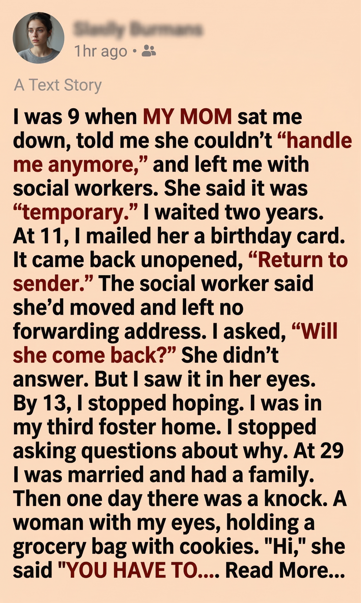
I was nine, proud of acing a spelling test, when I found her at the kitchen table with papers spread out.
“Stacey, sit down. We need to talk.” Her eyes were red. “I can’t handle you anymore. I can’t take care of you.”
She slid a paper toward me. I saw the word custody. “Social services are coming tomorrow.”
I cried, begged to stay. She promised it was temporary. The next morning, Mrs. Patterson arrived. Mom packed my clothes in a garbage bag. “Be good, Stacey. I’ll see you soon.”
I believed her.
The children’s home was cold, echoing. Every day I asked, “When is my mom coming back?” Mrs. Patterson always said, “Soon.”
For two years, I clung to that word. At 11, I mailed Mom a birthday card. Two weeks later, it came back stamped Return to Sender.
“She moved, didn’t she?” I asked. Mrs. Patterson hugged me, but her eyes told the truth.
By 13, in my third foster home, I stopped asking. Hope was dangerous. I learned to be small, quiet, acceptable.
At 27, I had my daughter, Emma. Holding her, I vowed she would never feel unwanted. Two years later, life was good—my husband Jake and I had a warm home, family photos on the walls, Emma’s toys scattered across the floor.
I worked at a marketing firm, we took vacations, had pizza nights, movie marathons. For the first time, I was living the life I’d dreamed of.
One evening, after putting Emma to bed, I heard it—knock, knock, knock. On the porch stood a frail woman with gray hair, clutching a grocery bag of cookies. Her eyes stopped me cold. They were my eyes.
“Hi,” she said softly. “You have to help me. I’m homeless. You’re my only child.”
She didn’t ask about my life, my family, or the years she’d missed. She stood there like I owed her something. I should have shut the door. Instead, I let her in.
She stayed on the couch, then the guest room. At first, she seemed grateful. But soon came the digs.
“Maybe if you weren’t so difficult back then, things would’ve been different.”
“I was nine,” I said.
“You were always crying, always needing attention.”
The breaking point came when I overheard her whispering to Emma: “Your mom was a tough kid. Sometimes you have to step back from people who hurt you—even family.”
Emma looked scared. That night, I packed her things in a garbage bag—the same way she’d packed mine.
“You need to leave,” I said.
“You can’t kick me out. I’m your mother!”
“No. You’re a woman who abandoned a child and came back for shelter, not forgiveness.”
I directed her to a shelter nearby. As she left, she warned, “You’ll regret this. Family is all you have.”
“No,” I said. “Love is all you have. And you gave up mine long ago.”
Weeks later, I mailed her a birthday card—blank, except for one line: Sometimes you have to step back from people who hurt you.
I don’t wonder about her anymore. I’ve learned what she never could: being a parent isn’t about what you take from your child, but what you give. And I’ll give Emma everything—including protection from those who would hurt her, even if they share her blood.
If you could give one piece of advice to anyone in this story, what would it be? Let’s talk about it in the Facebook comments.