For thirty-seven years, I was Patrick Miller’s wife.
Our marriage wasn’t romantic in the way movies like to pretend. It was made of routines—morning coffee, shared bills, quiet dinners, arguments that faded into silence. It wasn’t perfect, but it was honest. I believed that whatever happened—illness, age, hardship—we would face it side by side.
I was wrong.
The end came in a family courthouse in Cleveland. No shouting. No tears. Just signatures on paper and the dry sound of pages being stamped. Decades of life reduced to a few paragraphs written in legal language.
When it was over, Patrick didn’t hesitate.
He reached into his jacket and placed a bank card in my hand. It wasn’t dramatic. It wasn’t cruel in tone. That somehow made it worse.
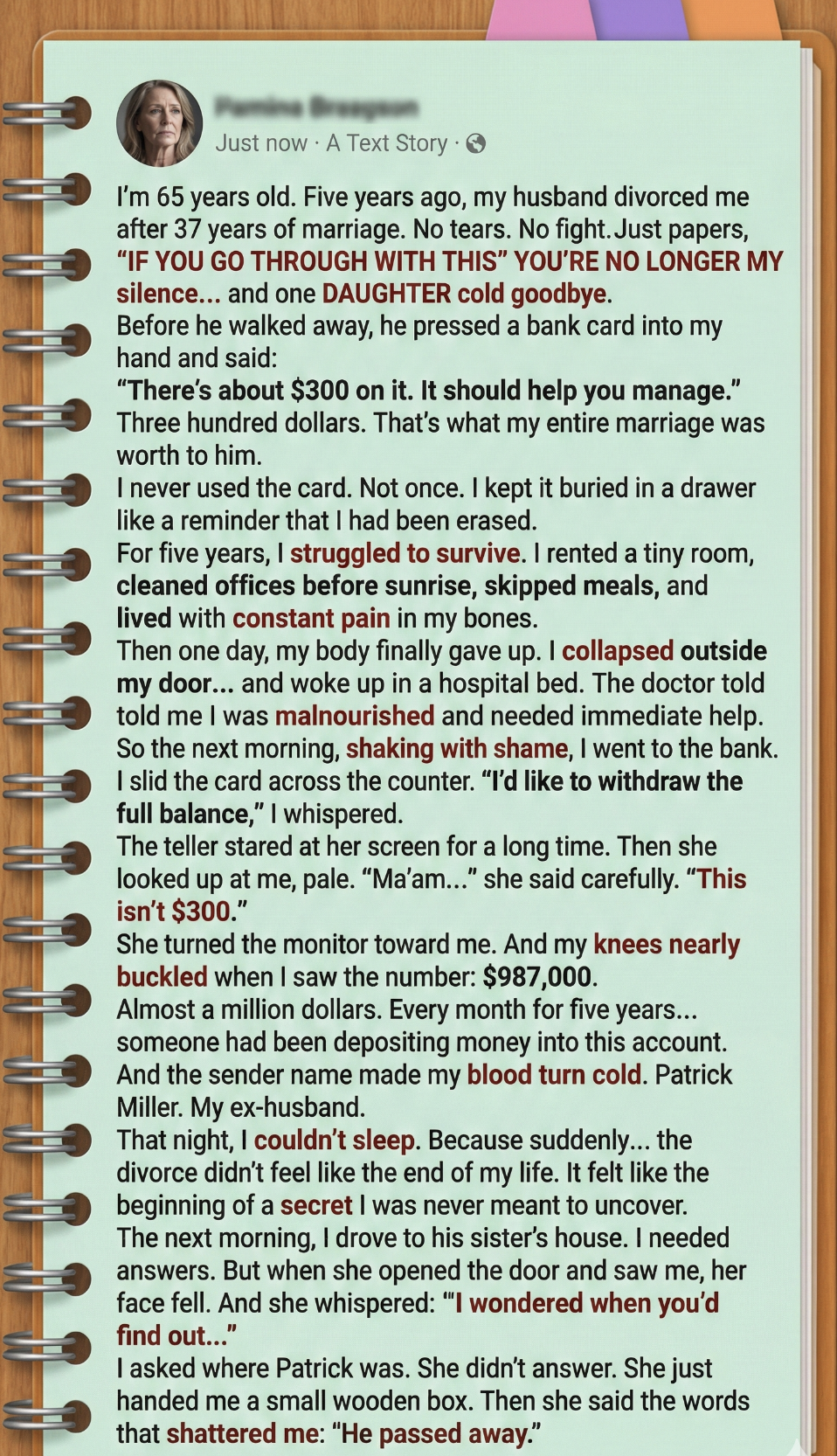
“There’s about three hundred dollars on it,” he said. “It should help you for now.”
That sentence hollowed me out.
Thirty-seven years of marriage—three hundred dollars.
No apology. No explanation. No goodbye.
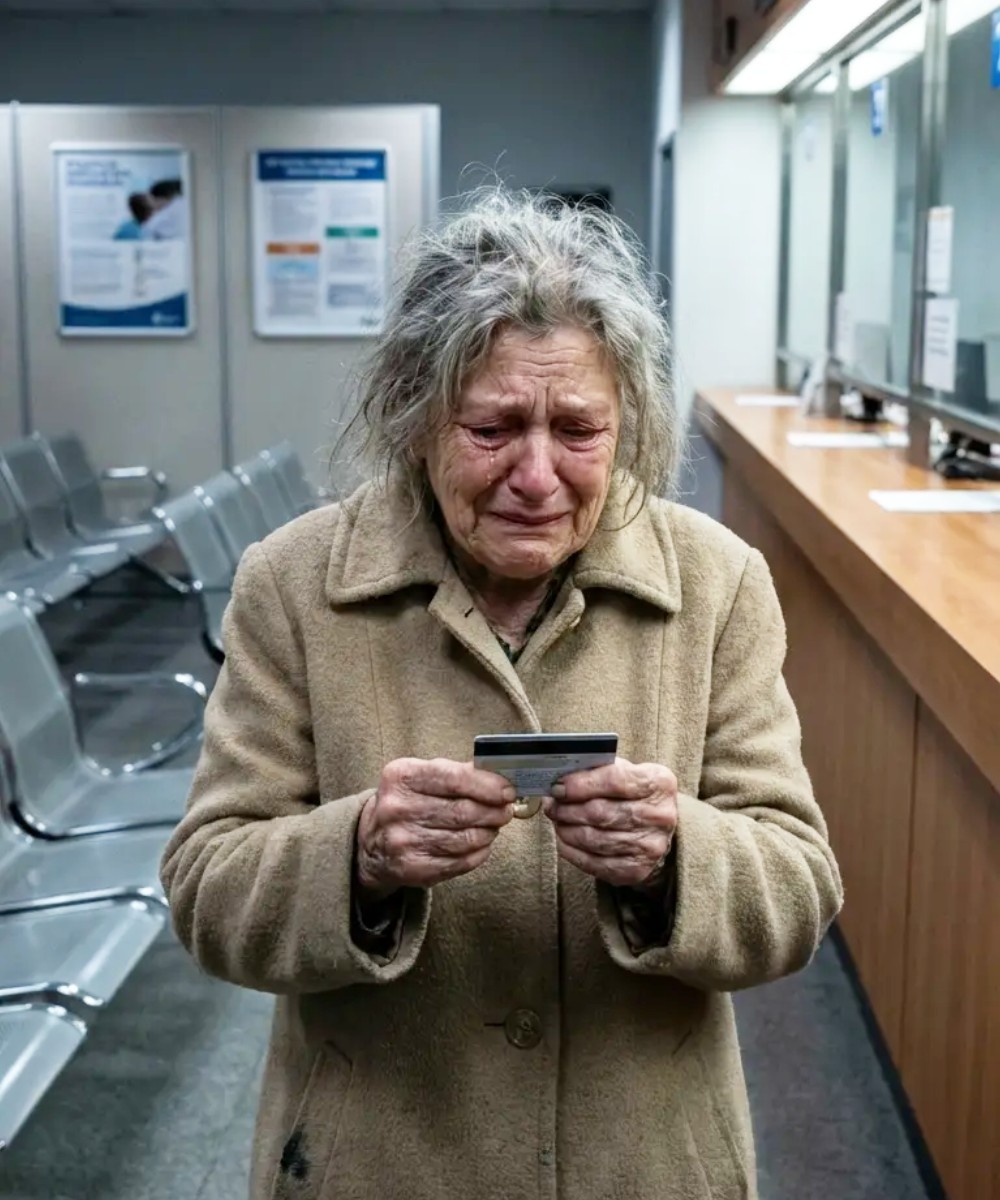
I stood there long after he walked away, holding that card like it weighed a thousand pounds.
I never used it.
I kept it in a drawer, untouched, because swiping it felt like agreeing with him—that my life had been worth so little. After the divorce, everything fell apart quietly. I rented a narrow room behind an aging grocery store. I cleaned office buildings before dawn. Some nights I went to bed hungry. Pain became a constant companion. Pride was the only thing I still owned.
Five years passed.
My body eventually made the decision my mind kept avoiding.
One afternoon, I collapsed outside my door. When I woke up, I was in a hospital bed, weak, dizzy, barely conscious. The doctor didn’t soften his words.
“You’re severely malnourished,” he said. “Another few months like this could have killed you.”
That night, lying under harsh fluorescent lights, I finally understood something: pride doesn’t keep you alive.
The next morning, I went to the bank.
My hands shook as I slid the old card across the counter. It was scratched, faded, almost embarrassing.
“I’d like to withdraw everything on this account,” I said quietly.
The teller frowned at her screen.
She stared longer than normal.
Then she looked up at me, her expression no longer polite—confused, cautious.
“Ma’am… the balance isn’t three hundred dollars.”
My heart began to pound.
She turned the screen toward me.
For a moment, I thought I was reading it wrong. I leaned closer. My vision blurred.
$987,000.
I couldn’t speak.
The teller asked if I was all right. I nodded, though I wasn’t sure I was breathing.
That card—the one I thought was an insult—wasn’t a dismissal at all. It was something else entirely. Something I still don’t fully understand.
But in that moment, one truth became painfully clear:
I had spent five years punishing myself for believing I had been worth nothing.
And all along, the story was far more complicated—and far more powerful—than I had ever imagined.
I felt my knees weaken as the truth hit me like a wave, and I realized that everything I believed for five years was about to collapse.
I left the bank in a daze, barely aware of the traffic, the noise, or the people rushing past me. Nearly one million dollars. The statement showed hundreds of identical monthly deposits, all from the same name.
Patrick Miller.
That night, sleep never came. I replayed moments from our final year together—the late nights he stayed awake, the sadness I mistook for indifference, the way he avoided long conversations. Memories rearranged themselves into something painfully clear. By morning, I knew I needed answers.
I drove to western Pennsylvania to visit Patrick’s older sister, Eleanor. She lived alone in a quiet town surrounded by farmland. When she opened the door and saw me, her face softened with grief.
“I wondered when you’d come,” she said.
“Where is Patrick?” I asked. “I need to talk to him.”
Her silence was answer enough. She invited me inside and returned holding a small wooden box.
“He passed away,” she said gently. “Five years ago.”
The room felt like it tilted beneath me. I could barely breathe. She explained that Patrick had been diagnosed with terminal cancer before the divorce. He knew he was dying. He didn’t want me to spend my final memories of him watching his body fail. So he chose distance. He chose to look cold. He chose to let me hate him—because he believed that pain would fade faster than grief.
The money was his way of staying. Every month, while fighting his illness, he transferred part of his savings to ensure I would be safe. He told Eleanor never to interfere unless I came looking for answers.
Inside the wooden box was a letter.
In it, he wrote that leaving me was the hardest decision of his life. He said the money wasn’t guilt or obligation—it was protection. He wanted me to eat well, live without fear, and grow old with dignity. He said he didn’t need forgiveness, only understanding.
I cried the way I hadn’t allowed myself to cry in years. For five years, I believed I was abandoned. In reality, I was loved quietly, consistently, until his final breath.
Standing before his photograph later that day, I realized how easily pride and silence can destroy truth. The card I thought symbolized rejection was actually a lifetime of care expressed in secrecy.
Love doesn’t always look like staying. Sometimes, it looks like letting go in silence.
Returning home, my life no longer felt like a punishment. It felt like a second chance—one paid for with sacrifice I never understood until it was too late. I moved into a small apartment, received proper medical care, and began rebuilding not just my health, but my sense of self. The money helped, yes—but the truth healed me far more than the financial security ever could.
What stays with me most is not the loss, but the lesson. How often do we assume cruelty when the truth is fear? How often do we let silence speak louder than love? Patrick believed protecting me meant breaking my heart. I believed dignity meant refusing help. Between us stood five years of unnecessary suffering, built entirely on pride and unspoken pain.
I don’t blame him anymore. I don’t blame myself either. We were two flawed people trying to love each other in the only ways we knew how. But if there is one thing I wish Americans—especially couples who’ve shared decades together—would take from my story, it’s this: don’t let assumptions replace conversations.
We live in a culture that values independence, strength, and “handling things alone.” But love doesn’t survive on silence. It survives on honesty, even when the truth is uncomfortable. If you’re hurting, speak. If you’re leaving, explain. And if someone hands you something that feels like rejection, pause before deciding what it means.
I visit Patrick’s grave every year on the anniversary of our divorce—not our wedding. It reminds me that love doesn’t always end when relationships do. Sometimes, it just changes form.
If this story moved you, ask yourself: Is there someone in your life you’ve misunderstood?
Is there a conversation you’ve been avoiding because it feels too late or too painful?
Share this story with someone who needs to hear it. Leave a comment and tell me what you would have done in my place—or what this story made you reflect on. Your voice might be the reminder someone else needs today.
Because sometimes, love is quiet.
And sometimes, understanding comes later than we wish—but it still matters.