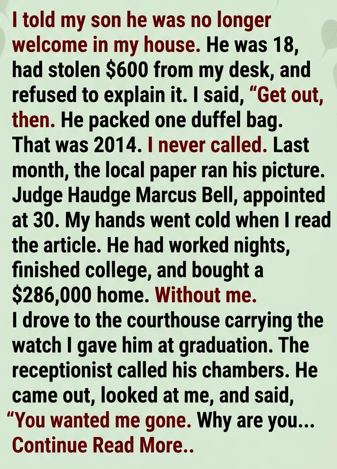
The receptionist looked at me for a long moment before quietly saying, “Judge Bell is ready for you.”
My heart pounded as I stepped into his chambers.
Marcus stood behind a large wooden desk, dressed in a black robe. The boy I remembered was gone. In his place was a confident man with tired eyes and silver beginning to show at his temples.
He stared at the watch in my hand.
For several seconds, neither of us spoke.
Then he said quietly, “You still have it.”
“I kept it,” I whispered. “I never stopped thinking about you.”
He looked away.
“You wanted me gone,” he said. “I believed you.”
My eyes filled with tears.
“I was angry. I thought you stole that money because you were becoming dishonest. I thought throwing you out would teach you a lesson.”
“You did,” he replied. “It taught me several.”
I sat down.
“Marcus, where did the $600 go?”
He took a long breath.
“I didn’t steal it for myself.”
I froze.
“What do you mean?”
He opened a drawer and pulled out an old envelope.
“I had a friend whose mother was about to lose their apartment. He was too ashamed to ask anyone for help. I took the money from your desk because I thought I’d replace it before you noticed.”
I stared at him.
“You should have told me.”
“I tried.”
My chest tightened.
“You came home that night and saw the money missing. You didn’t ask me where it went. You told me I was a thief.”
I couldn’t speak.
He continued.
“I was eighteen. I was scared. And when you told me to leave, I thought you had already decided what kind of person I was.”
Tears rolled down my face.
“I was wrong,” I said.
Marcus looked at me.
“Yes, you were.”
There was no anger in his voice anymore.
That somehow hurt more.
“I slept in my car for three weeks,” he said. “Then I got a job washing dishes at night. I went to community college during the day. Eventually I transferred to law school.”
I looked around his chambers.
“You became a judge.”
He gave a small smile.
“I wanted to become the kind of judge who remembered that people can make one mistake without becoming a bad person forever.”
I covered my face.
“Marcus, I’m sorry.”
He was silent for a long time.
Then he walked around the desk and sat across from me.
“I used to dream about you calling,” he said. “Every birthday. Every graduation. Every Christmas.”
My heart broke.
“Why didn’t you call me?”
“Because I thought if you wanted me in your life, you’d come looking.”
“I should have.”
“Yes.”
That one word shattered whatever defense I had left.
I reached across the table.
“I can’t change 2014. But if there’s any chance…”
He looked at my hand.
Then he slowly placed his hand over mine.
“There is a chance.”
I began to cry.
He didn’t pull away.
We talked for nearly three hours.
I learned about his first apartment, his first courtroom victory, the woman he had loved and lost, and the little house he had finally bought after years of saving.
Then he told me something that made my heart stop.
“The $600?”
“Yes?”
“I paid it back years ago.”
He smiled faintly.
“I sent it to your old address with a letter.”
“I never got it.”
“I figured.”
That night, after I returned home, I searched through an old box in the attic.
And there it was.
An unopened envelope.
My hands trembled as I pulled the letter out.
It was dated December 2014.
Inside were six hundred dollars and a note written in my son’s eighteen-year-old handwriting.
Mom, I’m sorry I scared you. I didn’t take the money because I wanted it. I took it because someone needed help. I know I should have asked. I hope someday you’ll understand. I love you.
I sat on the attic floor and sobbed.
For twelve years, I had believed I had thrown a thief out of my house.
The truth was much harder.
I had thrown out my son.
The next morning, I drove back to the courthouse.
Marcus was waiting outside.
I handed him the old letter.
He read it, then looked at me.
“You kept it?”
“I didn’t even know I had it.”
He smiled through tears.
“Maybe we both spent twelve years believing the other one didn’t care.”
I nodded.
“Can I ask you something?”
“What?”
“Would you come home for dinner?”
He looked at me for a few seconds.
Then he said, “Only if I get to bring dessert.”
I laughed for the first time in years.
“Deal.”
And as we walked toward the parking lot together, I realized something I wish I had understood when he was eighteen:
Sometimes the punishment you think will teach your child a lesson becomes the mistake you spend the rest of your life wishing you could undo.
I couldn’t give Marcus those twelve years back.
But I could make sure he never had to wonder again whether his mother loved him.
That evening, for the first time since 2014, my son sat at my kitchen table.
And when he reached for my hand, I held on.