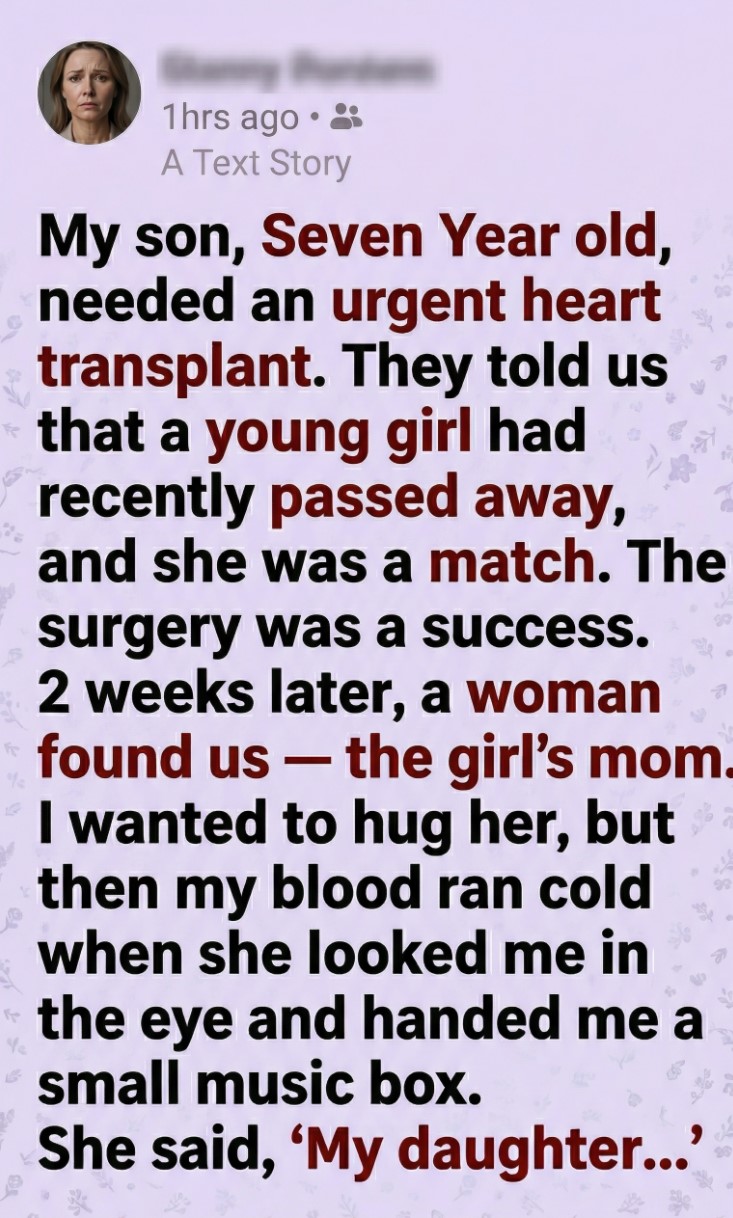
She said, “My daughter loved this song. It was the last thing she listened to before…” Her voice broke, but she steadied herself and pressed the music box into my hands.
I didn’t know what to say. Gratitude felt too small, and grief—hers, mine, somehow shared—hung heavy between us. I opened the box slowly. A soft, delicate melody filled the air, gentle and haunting. My son, standing beside me, tilted his head.
“I know that song,” he whispered.
My heart skipped. “What do you mean?”
He looked up at me, confused. “I… I heard it. In my dreams. After the surgery.”
The woman’s eyes widened, tears spilling over before she could stop them. “She used to hum it every night,” she said softly. “Since she was little.”
The melody played on, fragile notes threading through the silence. My son pressed a hand to his chest, right where the new heart beat. His expression changed—calm, almost distant.
“It makes me feel… safe,” he said.
The woman took a shaky step forward. “Can I?” she asked, gesturing toward him.
I hesitated for only a moment before nodding.
She knelt in front of him, her hands trembling as she gently placed one over his. Then, slowly, she moved it to his chest. She closed her eyes.
For a second, nothing happened.
Then her breath caught.
“…That’s her,” she whispered.
The room felt impossibly still, as if time itself was holding its breath. My son didn’t pull away. Instead, he covered her hand with his own.
“I think,” he said quietly, “she’s not gone.”
I felt tears blur my vision, but I didn’t wipe them away.
Neither did she.
The music box clicked softly as the song ended, but none of us moved. Because somehow, in that fragile, impossible moment, it didn’t feel like an ending at all.