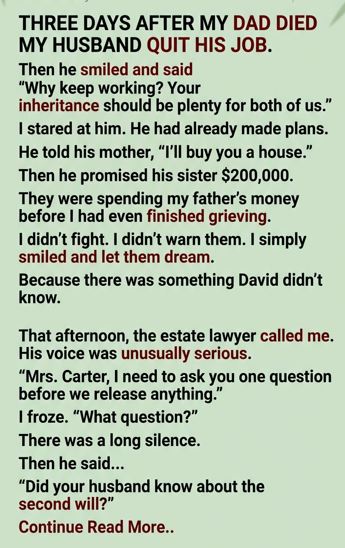
THREE DAYS AFTER MY DAD DIED, MY HUSBAND QUIT HIS JOB.
Then he smiled and said,
“Why keep working? Your inheritance should be plenty for both of us.”
I stared at him.
He had already made plans.
He told his mother,
“I’ll buy you a house.”
Then he promised his sister $200,000.
They were spending my father’s money before I had even finished grieving.
I didn’t fight.
I didn’t warn them.
I simply smiled and let them dream.
Because there was something David didn’t know.
That afternoon, the estate lawyer called me.
His voice was unusually serious.
“Mrs. Carter, I need to ask you one question before we release anything.”
I froze.
“What question?”
There was a long silence.
Then he said,
“Did your husband know about the second will?”
My heart stopped.
“What second will?”
The lawyer sighed.
“Then I think you need to come to my office.”
I drove there immediately.
When I arrived, my father’s longtime attorney, Mr. Harrison, was waiting.
He closed the door behind me.
“Your father changed his will eight months before he died.”
I stared at him.
“Why didn’t anyone tell me?”
“Because he specifically instructed me not to.”
He placed a sealed envelope on the desk.
My name was written across it.
My father’s handwriting.
I hadn’t seen it since the week he died.
I opened it with trembling hands.
The letter began:
My darling daughter,
If you’re reading this, then I’ve finally gone where you cannot follow me yet.
I smiled through tears.
Then I continued.
I know your husband believes my money will become his money.
I stopped.
I looked up.
“How did he know?”
Mr. Harrison said nothing.
I continued reading.
David has asked me questions about my estate several times.
My stomach tightened.
He pretends they’re innocent questions. They aren’t.
Then came the sentence that changed everything.
He has already planned how to spend money that doesn’t belong to him.
I looked at the lawyer.
“How long did Dad know?”
“Long enough.”
The letter continued.
I have watched how David speaks to you when he thinks no one is listening.
I’ve watched him become more interested in my health than in your happiness.
I watched him ask how much the house was worth.
And I watched him calculate your inheritance before I was even buried.
My eyes filled with tears.
I had noticed some of it.
But I had dismissed it.
I thought my father was simply being protective.
Then I reached the final page.
So I changed everything.
Mr. Harrison slid another document toward me.
“This is the second will.”
I read it.
My father had left me almost nothing directly.
Instead, he had created a protected trust.
The house was in the trust.
The investments were in the trust.
The business shares were in the trust.
And every distribution required my personal approval.
Then I saw another clause.
My inheritance could not be accessed, transferred, pledged, or used to satisfy my spouse’s debts.
My husband couldn’t touch it.
Not one dollar.
I stared at the page.
Then I laughed.
Not because it was funny.
Because suddenly everything made sense.
David quit his job because he thought he was about to become rich.
He had no idea he couldn’t touch the money.
But there was more.
Mr. Harrison handed me another folder.
“Your father asked me to investigate something.”
“What?”
“Your husband’s finances.”
I opened the folder.
Credit card debt.
Personal loans.
A second mortgage application.
Unpaid taxes.
And something else.
A purchase agreement.
David had already put a deposit down on a luxury house.
The contract was contingent on an inheritance he didn’t even have access to.
I felt sick.
“He was going to use my inheritance to buy this?”
“Yes.”
I flipped another page.
There were emails between David and his sister.
I read one.
Once she gets the money, Mom gets the house.
Another:
I’ll quit immediately. There’s no reason for me to work anymore.
Another:
She won’t fight us. She always feels guilty when family asks.
My hands went cold.
They weren’t just assuming I would share.
They had planned my money.
My future.
My father’s legacy.
Without asking me once.
I took the documents home.
David was sitting on the couch when I walked in.
He smiled.
“Everything okay?”
I nodded.
“Perfect.”
He stood.
“So? When do we get the money?”
I looked at him.
“We don’t.”
His smile disappeared.
“What?”
“The inheritance is protected.”
He laughed.
“Protected from what?”
“From you.”
His face changed.
“What does that mean?”
“It means my father knew exactly what you were planning.”
Silence.
I placed the second will on the table.
He read it.
His hands started shaking.
“This can’t be real.”
“It is.”
“You knew about this?”
“I learned today.”
He stared at me.
“You’re not going to let me have anything?”
I couldn’t believe what I was hearing.
“You quit your job three days after my father died.”
“I thought you were going to inherit—”
“You promised your mother a house.”
He said nothing.
“You promised your sister $200,000.”
“I was going to help them.”
“With money that wasn’t yours.”
He looked away.
Then he said,
“You’re my wife.”
“And?”
“We’re married. What’s mine is yours and what’s yours is mine.”
I stared at him.
“That’s not how love works.”
His face hardened.
“Your father poisoned you against me.”
“No.”
I pointed toward the folder.
“You did that yourself.”
He walked away.
For the next few days, he became a different person.
He begged.
Then he yelled.
Then he apologized.
Then he threatened divorce.
Then he begged again.
I stopped responding.
I contacted a financial advisor.
I reviewed every account.
And then I discovered something even worse.
David had been moving small amounts of money from our joint account for months.
Not huge amounts.
Just enough that I wouldn’t notice.
He had transferred nearly $18,000.
I confronted him.
He admitted it.
“I was preparing for our future.”
“No.”
“You were going to inherit millions.”
“I didn’t know that.”
“You knew your father was wealthy.”
“That doesn’t make your theft okay.”
He looked at me.
“You’re going to leave me over money?”
I shook my head.
“No.”
“Then why?”
“Because you showed me who you are when you thought I had money.”
He had no answer.
A week later, I filed for divorce.
David’s family exploded.
His mother called me selfish.
His sister called me greedy.
They said my father would have wanted me to share.
I sent them one copy of his letter.
The calls stopped.
Months later, the divorce was finalized.
David had to repay the money he had taken from our joint account.
He also lost the house deposit because he couldn’t complete the purchase.
His sister never received the $200,000.
His mother never received a new house.
And David had to return to work.
But the story didn’t end there.
One year after my father’s death, I received another letter from Mr. Harrison.
He asked me to come to his office.
When I arrived, he smiled.
“Your father left one more instruction.”
“What?”
He handed me a small key.
“This opens a safe deposit box.”
Inside the box was a photograph.
My father and me when I was eight years old.
On the back was a handwritten message.
“Money reveals people.
Don’t let it change you.”
Underneath was another sentence.
“Build something that helps people who never had what you had.”
I understood.
My father hadn’t left me money because he wanted me to become wealthy.
He left me freedom.
Freedom from fear.
Freedom from dependence.
Freedom from people who believed they were entitled to my future.
So I created a scholarship in his name.
Every year, it helps young people pay for college.
The first recipient was a single mother.
The second was a teenager whose father had died.
The third was a young man who had grown up in foster care.
I kept my own life simple.
I bought a modest home.
Went back to work.
And learned to enjoy the inheritance without allowing it to define me.
Years later, I ran into David at a grocery store.
He looked older.
Tired.
He asked how I was doing.
“I’m good.”
He nodded.
“I heard about the scholarship.”
“Yes.”
“My mother still talks about your father.”
I smiled.
“He was a good man.”
David looked down.
“I was wrong.”
I didn’t answer.
“I thought your inheritance would solve everything.”
I looked at him.
“It didn’t.”
He nodded.
“I thought money was the answer.”
“And now?”
He sighed.
“Now I know it just showed me the questions I was avoiding.”
I wished him well.
Then I walked away.
That night, I sat in my father’s old house.
The same house David had planned to give to his mother.
The same house he thought would become his.
I looked around.
For the first time, I wasn’t thinking about money.
I was thinking about my father.
He had known that grief could make a person vulnerable.
He had known that money could attract people who didn’t truly love you.
And most importantly, he had known me.
He knew I would struggle to say no.
So he had said it for me.
He had protected my future when I wasn’t strong enough to protect it myself.
I finally understood why he had kept the second will secret.
It wasn’t about punishing David.
It was about giving me time to see the truth for myself.
And he was right.
Three days after my father’s funeral, my husband thought he had inherited my father’s fortune.
Instead, he inherited the consequences of revealing who he really was.
And I inherited something far more valuable than money.
The freedom to choose who deserved a place in my life.