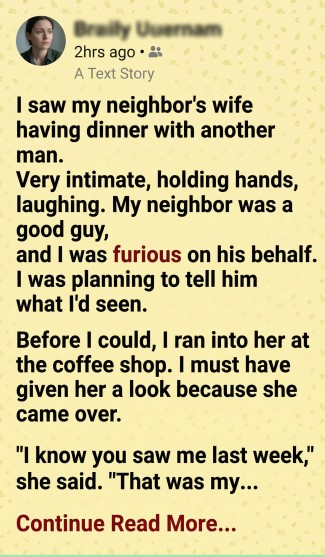
That was my… brother,” she finished, her voice steady, but her eyes searching mine for a reaction.
I blinked. Of all the things I had expected her to say, that wasn’t one of them.
“Your… brother?” I repeated, unsure whether to feel relieved or suspicious.
She nodded quickly. “He’s been going through a rough time. Divorce. Lost his job. I hadn’t seen him in years until last week. We were just… catching up.”
I thought back to what I’d seen—the way they leaned in close, the easy laughter, the way their hands rested together on the table. It had looked intimate. Too intimate.
Maybe she could see the doubt on my face, because she sighed and sat down across from me without asking.
“I know how it must have looked,” she said. “But my husband knows. I told him I was meeting my brother. You can ask him.”
That stopped me.
All the anger I’d been carrying for days, all the righteous indignation on behalf of my neighbor, suddenly felt… misplaced. Heavy in a different way.
“I was going to tell him,” I admitted quietly.
“I figured,” she said, offering a small, tired smile. “You’re a good neighbor. He’s lucky to have someone looking out for him.”
There was no defensiveness in her tone. No panic. Just honesty.
I leaned back in my chair, feeling a little foolish now. “I should’ve thought twice before jumping to conclusions.”
“It’s human,” she said. “We see a moment and think we know the whole story.”
For a second, neither of us spoke. The noise of the coffee shop filled the silence—cups clinking, espresso machines hissing, people chatting about ordinary things.
“I’ll clear it up with him anyway,” she added. “Just so there’s no weirdness.”
I nodded. “Yeah… that’s probably a good idea.”
She stood, giving me a polite nod before heading for the door. Halfway there, she turned back.
“And… thank you,” she said. “For caring.”
After she left, I sat there longer than I meant to, staring into my coffee as it went cold.
It’s strange how quickly a story can form in your head—how convincing it can feel. But the truth is, we’re almost always just seeing fragments. Snapshots. Not the full picture.
That evening, when I saw my neighbor taking out his trash, I almost said something. The words were right there.
But instead, I just waved.
And this time, I let the rest of the story belong to them.
