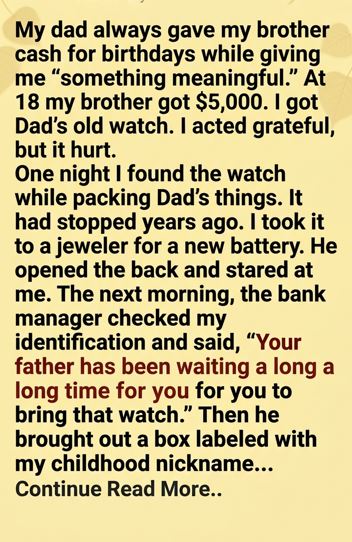
My dad always gave my brother cash for birthdays while giving me “something meaningful.” At 18, my brother got $5,000. I got Dad’s old watch. I acted grateful, but it hurt. One night I found the watch while packing Dad’s things. It had stopped years ago. I took it to a jeweler for a new battery. He opened the back and stared at me. The next morning, the bank manager checked my identification and said, “Your father has been waiting a long time for you to bring that watch.” Then he brought out a box labeled with my childhood nickname… Continue Reading… The box had my childhood nickname written across the top in Dad’s handwriting: “Little Star.” My hands started shaking. I hadn’t seen those words in years. The bank manager quietly placed the box in front of me and said, “Your father left very specific instructions. He told us that we were not to open this until you personally brought us this watch.” I looked at him in confusion. “Why would a watch matter?” He gave me a sad smile. “Because your father wanted you to understand that the watch was never just a watch.” Inside the box were dozens of envelopes, all dated from the year I turned eighteen. There were also photographs of me growing up, school certificates, drawings I had made as a child, and a letter sealed with my name. I opened the letter with trembling fingers. Dad had written, “My Little Star, if you are reading this, then I am no longer there to explain what I should have explained years ago.” I stopped breathing for a moment. “I know you thought I loved your brother more. I know you saw him receive money while you received things that seemed cheap or sentimental. And I know there were times when you went to bed wondering why you were always the one expected to understand.” Tears blurred the page. Then I read the next line: “The truth is, I never wanted you to measure my love by what I placed in your hands.” Dad explained that when my brother turned eighteen, he received $5,000 because that money came from a small account Dad had created for him when he was born. But when I was born, Dad had started something different. He opened an investment account in my name and quietly deposited money into it every month. He never told me because he wanted it to grow until I was old enough to understand what responsibility meant. The watch, he explained, contained the key to that account. Hidden beneath the inner mechanism was a tiny metal plate engraved with a number. That number matched the account Dad had created for me. I stared at the jeweler’s words from the previous day. “Your father has been waiting a long time for you.” Suddenly everything made sense. The watch had stopped years ago because Dad had intentionally removed the battery. He had told the bank that the day I brought it in would be the day I was finally ready to receive what he had left behind. The manager opened another folder. Inside was a statement showing the account balance. I looked at the number once, then twice, convinced I had misunderstood it. There were $187,000 in the account. I covered my mouth. “This can’t be mine.” The manager nodded. “Your father deposited money regularly for twenty years. He also left instructions that you could access the account immediately after his passing.” I began crying—not because of the money, but because for the first time I understood what Dad had been trying to tell me all those years. Every time he gave me an old book, a photograph, a piece of furniture, or something he called “meaningful,” I thought he was giving me less. But he had been saving something much greater for me. Then the manager handed me one final envelope. Dad had written only one sentence on it: “For the day you finally understand.” Inside was a photograph of my brother and me as children. On the back Dad had written, “I never wanted either of my children to feel less loved. If I failed at showing you that, I am sorry.” I sat there for a long time, remembering every birthday when I had smiled through disappointment. I remembered watching my brother count his money while I held Dad’s old watch in my hands. I remembered wondering what I had done wrong. Then I realized I had been measuring my father’s love with the wrong ruler. Before leaving the bank, I asked the manager one question. “Did my dad ever say anything about my brother?” He smiled and said, “He did. He told us that one day you might discover this account and feel guilty because your brother received less. He asked us to remind you that love isn’t a competition.” I walked out of the bank holding the old watch against my chest. For the first time, I didn’t see it as the gift Dad had given me instead of money. I saw it as the one thing he had trusted me to carry until I was ready to understand him. That evening, I went home and placed the watch on my nightstand. I didn’t repair it. I didn’t want to change it. It had stopped at the exact moment Dad wanted me to remember: sometimes the most valuable things in our lives don’t look valuable at first. A week later, I called my brother and asked him to come over. I showed him the letter and the account statement. He stared at me for a long time before saying, “I always thought Dad loved you differently.” I nodded. “So did I.” My brother sat beside me and started laughing through his tears. “Maybe he loved us differently because we needed different things.” We spent the rest of the evening talking about Dad—not about money, not about who received more, but about the memories we had misunderstood. Before my brother left, he looked at the watch and said, “You know what Dad would probably say?” I smiled. “What?” He said, “Stop looking at the price tag and look at the meaning.” For the first time in years, I laughed. And that night, I finally understood why Dad had called me his Little Star. He hadn’t given me less. He had simply been waiting for the right moment to show me just how much he had given.
I Found the Watch While Packing My Father’s Things