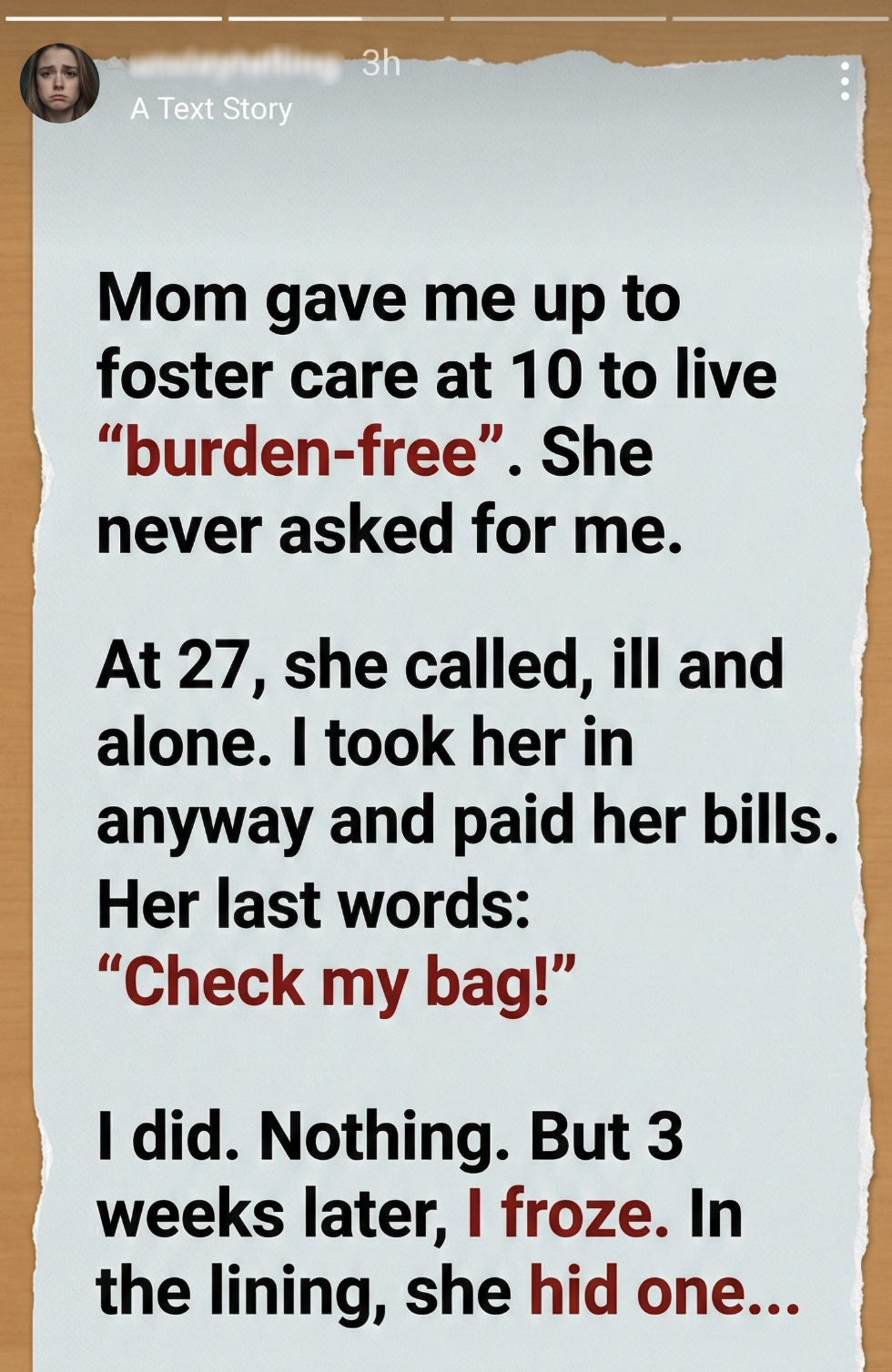
I was ten years old when my mother decided she didn’t want to be a mother anymore.
Not because she was dead.
Not because she was in prison.
Not because she was forced.
Because she was tired.
That’s the part that stayed with me the longest.
I remember sitting in the social worker’s office with a coloring book I didn’t want. The crayons were worn down and dull. The room smelled like cheap coffee and disinfectant.
My mom sat across from me, arms folded, looking like she was waiting for a bus.
The social worker spoke gently.
“Are you sure this is what you want, Linda?”
My mom didn’t hesitate.
“I can’t do this anymore. I want my life back.”
Then she looked at me—only for a second.
No tears.
No shaking voice.
No apology.
Just a cold, exhausted stare like I was something heavy she’d been carrying too long.
“Don’t make this harder than it has to be,” she said.
That was the last sentence she ever spoke to me as a mother.
And then she stood up, signed a paper, and walked out.
I remember thinking she’d come back.
That it was a mistake.
That she’d realize what she’d done.
But she never did.
Foster Care Taught Me What It Feels Like to Be Unwanted
The system didn’t beat me.
It didn’t starve me.
But it did something worse.
It taught me I was disposable.
I moved through four homes by the time I was thirteen.
Some were okay.
Some were loud and messy.
Some had rules so strict it felt like jail.
In one house, the foster mom called me “the burden” when she thought I couldn’t hear.
In another, they locked the fridge at night.
Every time I got attached, I learned to detach faster.
Because in foster care, people don’t say goodbye.
They just move you.
And after a while, you stop asking why.
I Tried to Forget Her
When I turned eighteen, I left the system with a trash bag full of clothes and a paper folder of documents.
That was it.
No parents waiting.
No family dinner.
No congratulations.
Just a caseworker shaking my hand like I was a stranger leaving a hotel.
I worked any job I could get.
Grocery store.
Warehouse.
Late-night diner shifts.
I went to community college part-time and kept my head down.
I didn’t date much.
Didn’t trust easily.
But I built a life.
A small apartment.
A stable paycheck.
A quiet routine.
It wasn’t glamorous.
But it was mine.
And for the first time in my life…
I wasn’t begging anyone to stay.
Then One Day… My Phone Rang
I was twenty-seven when I got the call.
An unknown number.
I almost ignored it.
But something in me—something I hated—answered anyway.
A woman’s voice came through.
Weak.
Breathless.
“Is this… Maya?”
My heart stopped.
Nobody in my life called me Maya anymore.
Not with that tone.
I knew before she even said her name.
It was my mother.
She sounded older than she should’ve.
Like life had chewed her up and spit her out.
“I know you probably don’t want to hear from me,” she whispered. “But… I’m sick.”
I didn’t speak.
She took my silence as permission.
“I don’t have anyone else,” she said. “I’m alone. I need help.”
The words hit me like a slap.
After seventeen years of silence…
After she erased me like a mistake…
Now she needed help.
And I hated myself because the first thing I felt wasn’t anger.
It was sadness.
Because no matter how much I tried to bury it…
Part of me still wanted a mother.
I Let Her Come Live With Me
Two days later, she showed up at my door.
She looked nothing like the woman who left me behind.
Her hair was thin and gray.
Her face sunken.
Her hands trembling.
She carried one worn-out leather bag and a plastic grocery sack.
She didn’t hug me.
She didn’t apologize.
She just walked into my apartment like she belonged there.
And I remember thinking…
Even now… she still thinks she has the right.
But I didn’t kick her out.
I gave her my bed and slept on the couch.
I cooked her meals.
I drove her to doctor appointments.
I paid for prescriptions.
Paid her overdue phone bill.
Paid her medical debt.
She watched TV all day, mostly silent, and only spoke when she wanted something.
Sometimes she would stare at me like she was trying to recognize who I had become.
But she never asked about my life.
Never asked where I grew up.
Never asked what foster care did to me.
Never asked if I ever cried myself to sleep wondering why I wasn’t enough.
She never said the words I waited my entire childhood to hear:
“I’m sorry.”
And still…
I took care of her.
Because I told myself…
Maybe this was my chance to be better than her.
The End Came Quietly
Three months after she moved in, her health declined fast.
She couldn’t stand without help.
Couldn’t eat much.
Couldn’t breathe without coughing.
The doctors said the word “terminal” like it was just another file on their desk.
I stayed by her hospital bed for hours.
Even though every part of me wanted to scream.
Even though I felt like I was caring for a stranger who ruined my life.
One night, close to the end, the nurse stepped out and the room grew quiet.
My mom turned her head slowly toward me.
Her eyes were watery.
Her voice was barely there.
“Maya…”
I leaned in.
“What?”
She swallowed, like speaking hurt.
Then she whispered her final words.
“Check my bag.”
That was it.
No goodbye.
No apology.
No love.
Just… “Check my bag.”
And then her eyes drifted closed.
She died less than an hour later.
I Checked Her Bag Immediately
When I got home, I sat on my kitchen floor with her leather bag.
My hands shook.
I don’t know why I expected something meaningful.
A letter.
A photo.
An apology.
A confession.
Something that proved she had a heart.
I opened it.
Inside was a cheap hairbrush.
Old medication bottles.
A wallet with almost nothing in it.
A few wrinkled receipts.
A cracked phone charger.
Nothing else.
No letter.
No message.
Nothing.
I stared at it for a long time.
Then I laughed.
Not because it was funny.
Because it was so perfectly her.
Even in death…
she managed to disappoint me one last time.
I zipped the bag shut and shoved it into my closet.
I didn’t want to look at it again.
Three Weeks Later… I Found It
After the funeral, life returned to normal.
Quiet apartment.
Quiet evenings.
But something felt unfinished.
Her words kept replaying in my mind.
“Check my bag.”
I’d already checked it.
So why would she say that?
One night, I was cleaning out the closet, ready to throw the bag away.
As I lifted it, I felt something strange.
Not inside.
Inside the bag itself.
The leather felt thicker on one side.
I froze.
Slowly, I ran my fingers along the bottom seam.
Then I noticed it…
A tiny stitch line that didn’t match the rest.
Like it had been sewn back together by hand.
My heartbeat turned loud.
I grabbed a pair of scissors from the kitchen drawer.
And I cut the seam open.
The leather split slightly.
And something slipped out.
A folded plastic sleeve.
Then another.
Then another.
I pulled them out with shaking hands.
Inside were documents.
Old.
Yellowed.
Carefully protected.
I opened the first one.
And my breath caught in my throat.
It was a court paper.
My name was on it.
Then I saw another document.
A savings bond.
Then another.
A bank statement.
Then more.
I flipped through them, confused and terrified.
And then I saw the number that made my stomach drop.
$48,300
There was a savings account.
In my name.
Opened when I was nine.
The date matched the year before she abandoned me.
And according to the paperwork…
She had been depositing money into it.
Every month.
For years.
Even after she gave me up.
Even after she disappeared.
Even after she never called.
Then I Found the Letter
At the very bottom, taped inside the lining…
was a folded envelope.
My name written on it.
“Maya.”
My hands trembled as I opened it.
Inside was one piece of paper.
Her handwriting was messy and shaky, like she wrote it when she was already dying.
I read it slowly.
And the words punched the air out of my chest.
The Letter Said:
Maya,
I don’t deserve forgiveness.
I don’t even deserve to say your name.
When you were ten, I didn’t give you away because I didn’t love you.
I gave you away because I was weak.
Because I was addicted.
Because I was drowning.
And I knew I would ruin you if you stayed.
So I did the only thing I could do.
I walked away before you watched me destroy myself.
I told people I wanted to live “burden-free” because it was easier than admitting I was ashamed.
But I never forgot you.
Every month I saved money. Not because it fixes anything.
Because it was the only way I could still be your mother without touching your life again.
I watched from far away. I knew where you lived. I knew you were working. I knew you were surviving.
I wanted to reach out so many times.
But I didn’t want to poison your life again.
When I got sick, I was scared.
And I was selfish.
I came to you because you were the only good thing I ever made.
You took care of me when I didn’t deserve it.
And I will die with that guilt.
The money isn’t enough. The letter isn’t enough.
But I need you to know this:
You were never unwanted.
You were never a burden.
I was the burden.
And you survived me.
I’m sorry.
– Mom
I Sat There Crying for an Hour
I couldn’t breathe.
I read it again.
And again.
And I hated her.
And I missed her.
And I felt like my entire childhood had been rewritten with one letter.
Because for seventeen years…
I believed I was thrown away because I wasn’t worth keeping.
But the truth was uglier and sadder:
She threw me away because she couldn’t face her own failures.
She abandoned me because she knew she wasn’t safe.
And she spent the rest of her life paying for it in silence.
The Ending That Changed Everything
The next day, I went to the bank.
The account was real.
The money was real.
And when the teller slid the paper across the counter, she smiled politely and said:
“Looks like someone really wanted you to have a future.”
I nodded.
But I couldn’t speak.
Because the truth was…
my mother gave me up…
but she never stopped carrying me.
Just in the worst, quietest way possible.
What I Did With the Money
I didn’t buy a car.
I didn’t go shopping.
I used it to do something I never thought I’d do.
I paid off my student loans.
Then I enrolled in nursing school.
Because if there was one thing I learned from her final months…
it was that sickness doesn’t care if you deserve love or not.
And people still need someone to stay.
Now I work in a hospital.
I sit with patients who are alone.
I hold hands.
I listen.
I tell them they matter.
Because I know what it feels like to be forgotten.
And I know what it feels like to be remembered too late.
And Sometimes… I Still Think About That Bag
That cheap old leather bag.
The one she carried to my apartment.
The one she told me to check.
The one that held the only apology she ever had the courage to give.
And every time I remember it…
I realize something that still hurts to admit:
She wasn’t a good mother.
But at the very end…
she tried to be.
And maybe that’s the most human ending of all.
THE FINAL LINE
She lived her whole life running from responsibility…
but in the last place she could hide anything…
she hid the truth.
Not in her words.
Not in her actions.
But in the lining of a bag…
where she knew I would eventually find it.
And finally understand:
I was never the burden.
She was.