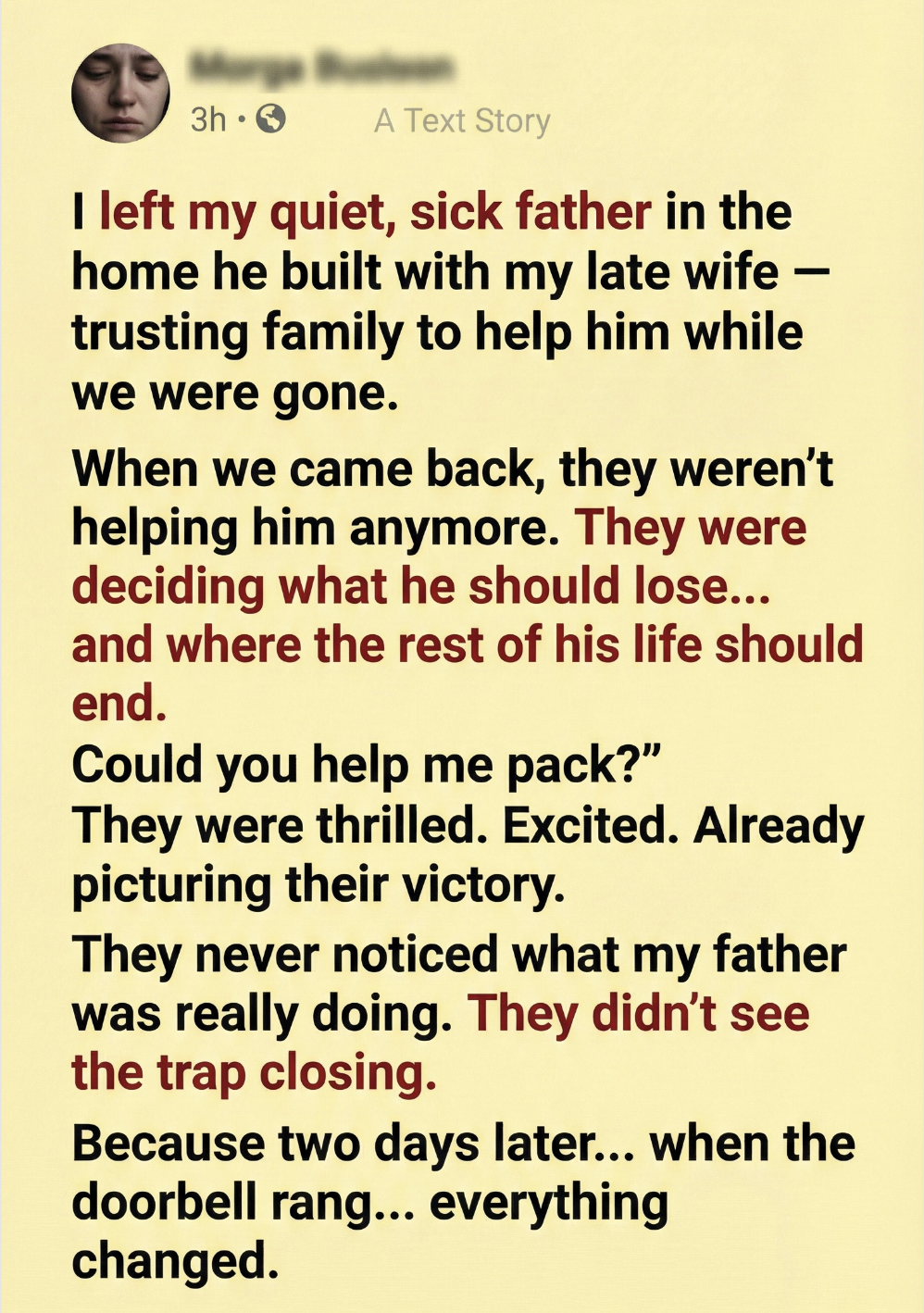
I left my father in his own home, trusting family to look after him.
That house wasn’t just walls and rooms.
It was his life.
He built it with my mother when they were young and hopeful. He carried her through its halls when cancer made her weak. He held her hand in the living room the night she died.
After that, my dad became quieter.
Softer.
The kind of man who says “it’s fine” even when it isn’t.
When we had to leave town for a week, I asked my in-laws to stay with him.
Just help with meals.
Just make sure he took his medication.
Just keep him company.
I thought I was being responsible.
The first warning signs came quickly.
My dad stopped calling at his usual time.
When I did reach him, his answers were short. Careful. Like he didn’t want to complain.
“They’re fine,” he said.
“Don’t worry.”
When we came back, I felt it the moment I walked into the house.
The air was different.
His favorite chair was pushed aside.
The TV was blaring shows he never watched.
Food he liked was gone from the fridge, replaced with things he couldn’t even eat.
My in-laws laughed loudly. Took up space. Spoke over him.
They acted like guests who had decided to become owners.
Then came the moment that shattered something in me.
We were all sitting at the table when my mother-in-law laughed and said,
“You don’t need a whole house anymore. A nursing home would be perfect for you.”
My father didn’t respond right away.
He stared at his hands.
The same hands that built that house.
The same hands that buried his wife.
I waited for him to say no.
He didn’t.
He smiled politely and said,
“You’re right. Maybe it’s time I moved out. Could you help me pack?”
They were thrilled.
They talked about how practical it would be. How much easier. How he’d be “taken care of.”
They didn’t notice what I did.
My father wasn’t agreeing.
He was ending the conversation.
That night, I found him sitting alone in the dark.
“I didn’t want to make trouble,” he said quietly.
“I’m tired of fighting.”
That was the moment I realized something terrifying.
They hadn’t broken him.
They were counting on him already being broken.
The next morning, my dad made a phone call.
Not to a nursing home.
To his lawyer.
Two days later, the doorbell rang.
When my in-laws answered it, their smiles vanished.
The house was no longer my father’s.
It belonged to a trust my parents had set up decades ago — one that transferred control to me if he was ever pressured or declared “unfit.”
And my father?
He wasn’t moving into a nursing home.
He was moving in with us.
Quietly.
With dignity.
On his own terms.
The look on my in-laws’ faces was something I’ll never forget.
They had come to take advantage of a gentle man.
Instead, they exposed themselves.
My father hugged me before he left that house for the last time.
“I didn’t lose my home,” he said.
“I just learned who it was never meant for.”
And for the first time in a long while…
He smiled —
and meant it.