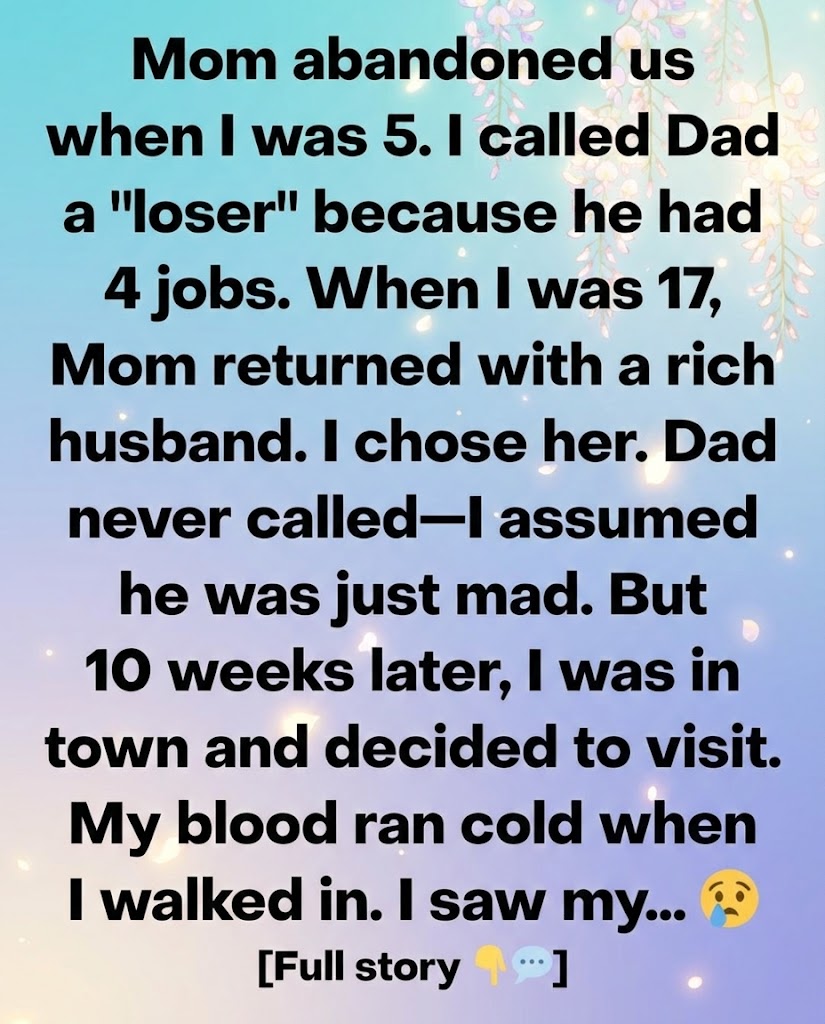
I was five years old when my mother packed a single suitcase and walked out the door. I remember standing at the window, my fingers pressed to the glass, waiting for her to turn back. She never did. From that day on, it was just my dad and me.

He worked four jobs. Four. He left before sunrise and came home long after dark, his clothes smelling of grease, sweat, and cheap coffee. His hands were always rough, his eyes always tired. And yet, we were still poor. The fridge was often half empty. My clothes came from thrift stores. I watched other kids get new toys and new shoes, and bitterness took root in my chest.
By the time I was a teenager, that bitterness turned into anger.
I called him a loser.
I told him that if he worked so hard and we were still struggling, then maybe he just wasn’t good enough. I said it with venom, with all the cruelty only a confused, hurting kid can manage. I expected him to yell. To punish me. To defend himself.
He never did.
He would just smile—soft, patient—and say nothing. That silence annoyed me even more. I mistook it for weakness. I didn’t understand that it was strength.

When I was seventeen, my mother came back.
She arrived in a shiny car, wearing expensive perfume and jewelry that caught the sunlight. She had a rich husband, a big house, and stories about a “new life.” She spoke as if the past were an inconvenience, something she’d simply stepped away from. And I let myself be dazzled.
When she offered to take me with her, I didn’t hesitate.
I packed my things and left my dad standing in the doorway of the same small house he’d broken himself to keep. He didn’t beg me to stay. He didn’t cry. He hugged me and said, “If this is what you want, go.”
He never called after that. I told myself he was angry. Too proud to reach out. So I didn’t call either.
Ten weeks later, I came back to town to visit some old friends. On impulse, I stopped by our house.
The front door creaked open, and my blood ran cold.
The place was almost empty. No couch. No TV. No photos on the walls. It felt like walking into a memory that had been erased. A neighbor saw me standing there and rushed over, eyes full of pity. She told me my dad had been in a terrible car crash. Multiple surgeries. He’d sold everything—everything—to pay hospital bills and stay alive.
I ran to the hospital.

When I saw him, tubes everywhere, face pale and thinner than I remembered, my knees nearly gave out. I broke down, sobbing, begging him to forgive me for leaving. For choosing my mother. For calling him a loser.
He opened his eyes and smiled.
“I always knew you’d come back,” he whispered. “I know the kid I raised.”
I called my mother, desperate, begging for help. Her voice was cold, detached. “If you’re choosing him,” she said, “don’t bother coming back.”
That moment shattered the last illusion I had about her.
I stayed with my dad. I slept on the hospital floor. I helped however I could. Days later, he slowly began to recover. And as I watched him fight his way back to life, I finally understood the truth.
He never gave up on me—even when I gave up on him.
That’s what real love looks like.