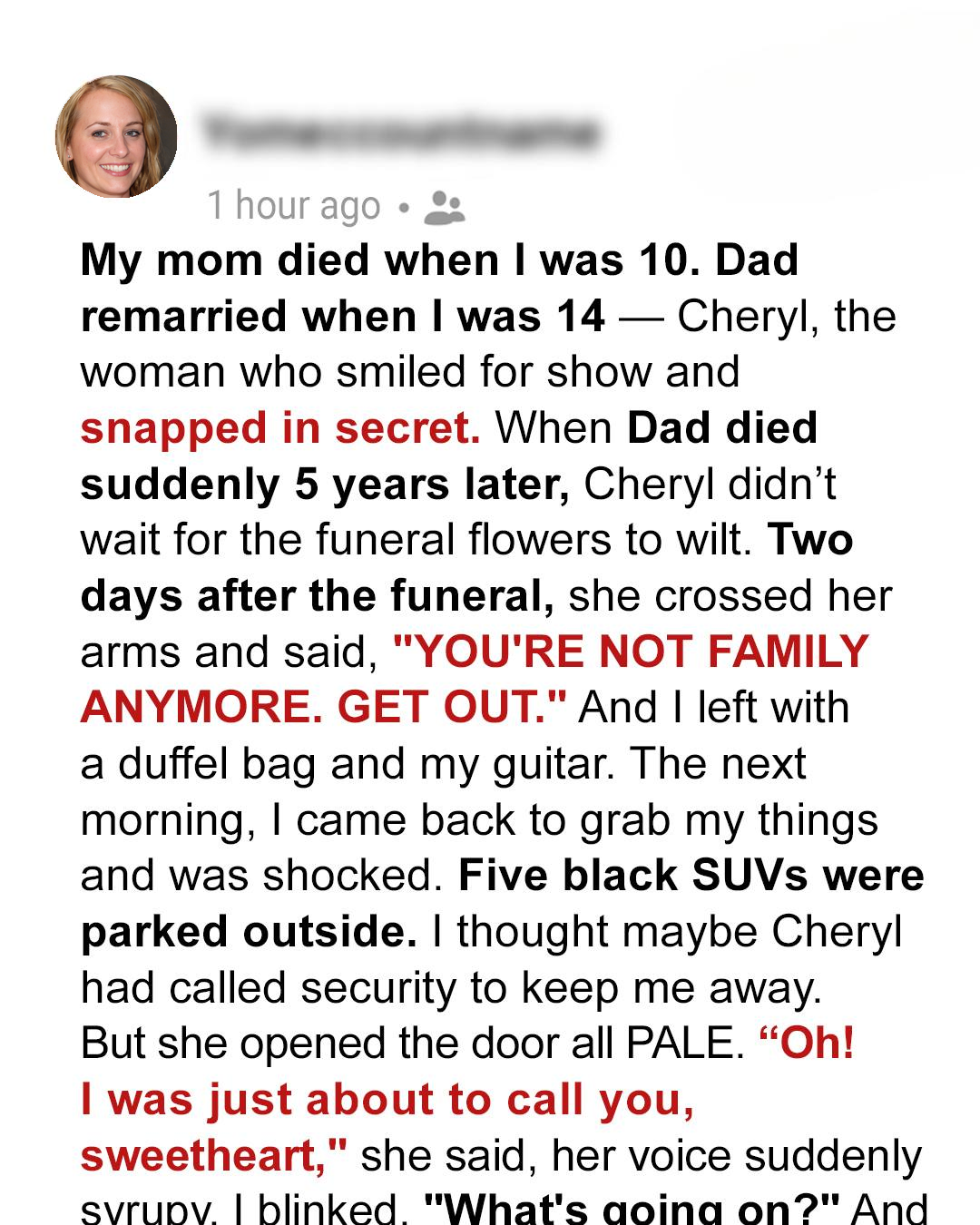
Losing my mom when I was just ten years old was, without a doubt, the most devastating experience of my young life. The world felt like it had tilted on its axis, and I struggled to find my footing in the aftermath. My dad, bless his heart, did his best to fill the void, but the house felt empty, and a piece of my heart ached with a constant, dull throb. When I was fourteen, Dad announced that he was remarrying. Her name was Cheryl, and on the surface, she seemed pleasant enough. She had that practiced, almost plastic smile that some people wear like a mask, and she spoke in a tone that always seemed just a bit too sweet. I tried to be open-minded, but something about her never quite felt genuine. Looking back, I realize that my instincts were spot on, but at the time, I desperately wanted to believe that maybe, just maybe, things could get better. Cheryl moved in, and the dynamic of our household shifted in ways that were both subtle and profound. She was all sweetness and light when Dad was around, but the moment he left the room, her demeanor would change. The smile would vanish, replaced by a cold, calculating expression, and her voice would take on a sharp, almost biting edge. She made little digs at me, criticizing my clothes, my friends, my music – anything she could find to pick at. I tried to ignore her, to brush it off as just her personality, but it wore me down over time. I started spending more time away from home, finding solace in my guitar and my music.
…………………………………………..
 [ CONTINUE READING ]
…………………………………………..
Then, when I was nineteen, Dad died suddenly. It was a heart attack, completely unexpected. One moment he was there, and the next he was gone. The grief was overwhelming, a tidal wave that threatened to pull me under. Cheryl, to my surprise, seemed genuinely distraught. She cried and clung to me, and for a brief moment, I thought that maybe, just maybe, we could find some common ground in our shared loss. I was wrong.
Two days after the funeral, while the flowers were still fresh and the condolences were still pouring in, Cheryl summoned me to the living room. She stood there, arms crossed, her face a mask of cold indifference. Without a trace of emotion in her voice, she delivered the blow: “YOU’RE NOT FAMILY ANYMORE. GET OUT.” I was stunned. I couldn’t believe what I was hearing. This was my home. This was where I had grown up. But Cheryl was resolute. She wanted me gone.
I packed a duffel bag with a few essentials – clothes, my toothbrush, and a couple of photographs. I slung my guitar over my shoulder and walked out the door, feeling lost and alone. I spent the night at a friend’s house, trying to make sense of what had happened. How could someone be so cruel? How could someone kick me out of my home just days after my father’s death?
The next morning, I decided to go back to the house to retrieve the rest of my belongings. I needed my music equipment, my books, my clothes – everything that made up my life. As I approached the house, I was met with a bizarre sight. Five black SUVs were parked in the driveway, their windows tinted, their engines idling. My first thought was that Cheryl had called security to keep me away. That she was so afraid of me that she needed to hire bodyguards to protect her. But as I got closer, I saw Cheryl standing on the porch, her face pale and drawn.
She saw me coming and forced a smile. “Oh! I was just about to call you, sweetheart,” she said, her voice dripping with a saccharine sweetness that I knew was completely fake. I blinked, trying to process the scene before me. “What’s going on?” I asked, my voice barely above a whisper. What could possibly warrant five black SUVs and a panicked Cheryl? The answer, I soon discovered, was more shocking and unbelievable than anything I could have ever imagined.